![[TheFounder] "The Gap Between Insight and Action is Where Customers Churn"- Teemu Kinos, Skene](https://sgogyjibcpuwvlxvxzow.supabase.co/storage/v1/object/public/blog-media/blog/images/1770216772949_oa2zre_2.png)
The hottest topic in the recent SaaS market is undoubtedly 'Agents.' While software of the past stopped at analyzing data to say, 'Here is a problem,' we are now shifting to an era where AI executes solutions, saying, 'I found the problem and fixed it.'
Teemu Kinos is an entrepreneur delivering the most provocative message at the forefront of this shift. He boldly claims that existing analytics dashboards are misleading developers. He points out that the so-called 'Frankenstein Stack' - a patchwork of dozens of tools - only throws questions at you without solving the actual problems. He asserts that 'Growth is no longer a matter of marketing intuition, but an area that must be engineered with code.'
We interviewed Teemu Kinos, CEO and Co-founder of the Finnish startup Skene, who recently proved his vision by securing pre-seed funding from NVIDIA executives and Superhero Capital.
🗣️ Who is Teemu Kinos?

Q1. Thank you for joining us. After a successful exit and a stable executive career, what specific market frustration or problem compelled you to return to 'Day 1' and build again?
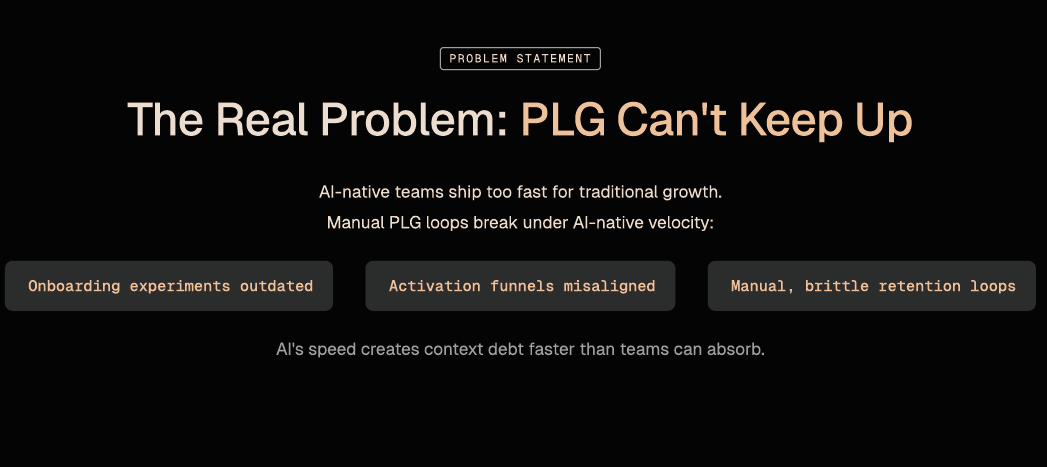
Most growth tools are lying to developers. They give you dashboards full of numbers and then say: 'Figure it out.' That's not actionable. That's a homework assignment.
Growth tools don't understand your product. You're staring at a dashboard that says '15% churn' thinking: Okay, but what do I actually change in my code? Meanwhile, the typical VC-backed startups run what I call the 'Frankenstein Stack' - Segment, HubSpot, Intercom, Mixpanel, Optimizely - paying $2,000/month for tools that create more questions than they answer.
The traditional PLG cycle takes months to iterate. That's the execution gap. Dashboards show you problems; they don't fix them. We're building infrastructure that collapses that gap. Skene understands your codebase and product, not just your analytics.
When it tells you 'users who don't execute saveData() within 7 days churn at 85%,' you don't just know the metric. You know the exact file, function, and line of code causing the problem. That's not analytics. That's code-level insight that leads directly to code-level fixes, which we can share a ready-made prompt for.
The shift is from dashboard-first to code-first. From reading metrics to reading source code. From 'here's what happened' to 'here's what to change.' Charts don't fix problems. Shipping code stops churn.
Q2. I noticed on your profile that when you started your first venture in 2013, you listed "Confidence" under your skills. That’s brilliant. Now, after experiencing a successful exit with GetJenny, has your mindset as an entrepreneur changed compared to back then?
In 2013, I didn't know enough to be scared. Five friends from business school, zero developers, a lot of Excel spreadsheets that made everything look like a sure thing. That wasn't courage, it was just not knowing better. Now I know exactly how hard this is. I've raised money and spent it on the wrong things. I've tried to scale by hiring when I should have stayed lean. I've burned out badly enough.
Strangely, that makes it easier to start again, not harder. When you've already survived the worst parts of building a company, the uncertainty stops being scary. You stop fearing what might go wrong because you've already lived through most of it. What remains is just the work. The main difference now is discipline. I know which mistakes I won't make twice.
Q3. You advocate for 'Building' with Skene rather than 'Buying' external tools. However, to play devil’s advocate: In an era of advanced AI coding assistants like Cursor, a skilled developer could theoretically build these growth loops from scratch. If 'building' is becoming easier, what is the critical differentiator that makes Skene necessary?
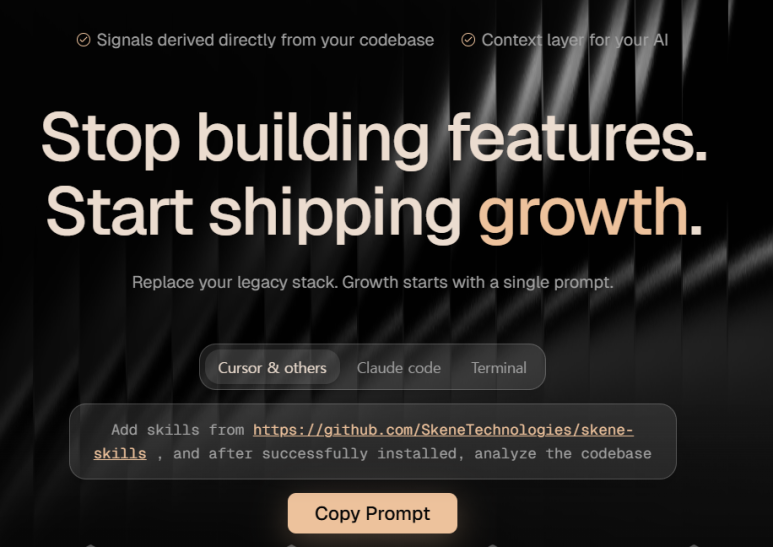
This is exactly why we're open-sourcing the core technology. Building isn't the differentiator, execution is. The hard part isn't understanding what's wrong with your customer journey. The hard part is actually fixing it, continuously, at scale. So we're giving away the tools to build. The open source version lets anyone analyze their codebase and identify adoption gaps.
But our upcoming service focuses on the execution layer, delivering a proactive user experience to end users with the shortest path to value. Not just insights, but actions. Not just 'here's what's broken,' but 'here's the fix, deployed.'
Mårten Mickos at MySQL had a clean way of segmenting this: if you have time and no money, use the open source version. If you have money but no time, use the service. We're betting most growing companies fall into the second category. They don't need another tool that just shows them the problems. They need one that delivers fixes and executes them. That is what growth infrastructure is.
Q4. While you speak about 'Growth' as a marketing goal, your methodology leans towards AI agent optimization. Do you view Skene primarily as a tool for 'Marketing Outcomes' or as an innovation in 'Operational Logic' where AI executes business tasks?
Both. They're the same thing when you get the architecture right. Traditional customer success has a handoff problem. Analytics tools identify issues. Then humans interpret dashboards, design interventions, write copy, set up campaigns, and finally ship something weeks later.
The gap between insight and action is where customers churn. We're collapsing that gap. The AI agent identifies a pattern, generates the intervention, and can deploy it, without waiting for a human to translate between systems. That's not marketing or operations. It's just the product doing what it should do: helping customers succeed.
The practical passion is for the infrastructure layer. Getting the architecture right so that insights automatically become actions. But the point of good infrastructure is better outcomes. They're inseparable.
Q5. Congratulations on your €800k pre-seed round. The news that NVIDIA executives participated has become a hot topic in the industry. What is the strategic significance of this validation for Skene?
Three things matter beyond the capital.
First, market timing validation. Five years ago, asking companies to let AI analyze their codebase would have been a hard sell. Now it's table stakes; developers already use AI coding tools daily. Investors backing this are betting the same behavior extends to customer success.
Second, forced prioritization. With limited runway, you can't pursue everything. The funding forces prioritization: build for the early adopters who get it, not the mainstream that needs convincing.
Third, accountability structure. We're building in public with a stated goal: €1M ARR by Q1 2026. That's not marketing, it's a forcing function. It builds unity and clarity. Public commitments create accountability. If we hit it, the transparency helped. If we miss it, we learn something about where the model breaks.
Building in public isn't about getting attention. It's about creating feedback loops. When you share what you're building and why, people tell you when you're wrong. That's more valuable than polished messaging that nobody challenges.
Q6. What has been the biggest challenge in founding Skene so far? Could you share a specific moment that tested your capabilities as a founder, and how you overcame it?
We are still fairly new; we’ve been working full-time with Skene since September. Operationally, it has been surprisingly smooth, which is a testament to the co-founders and the team. We have gone from building a traditional dashboard application to delivering an open-source product that developers can interact with directly within development environments such as Cursor or Claude Code.
Some of the early challenges revolved around companies or users not being willing to grant a product access to their codebase. We did invest time into figuring out additional ways of teaching the agents, but then just understood that these companies are our 'anti-ICP.' Understanding who our solution is not for is just as important as figuring out who it is for.
Q7. You are building on the Model Context Protocol (MCP). How do you envision your product evolving on this foundation, and what unique value will it unlock in the next stage?
MCP is the protocol layer; it lets LLMs interact with codebases in a standardized way. That's the foundation, not the product. The product is AI agents specialized for product-led growth and lifecycle stages.
● Now: Code analysis that maps your product's adoption topology. Where does value get delivered? Where do users get stuck?
● Next: Software-level understanding by creating context from not only code, but the data in the stack (e.g., data from Supabase or billing from Stripe).
● Eventually: Closed-loop optimization. The agents don't just identify problems; they generate fixes, deploy them, measure results, and iterate.
Continuous improvement without human bottlenecks. The team makes this possible. Michele has a PhD in physics and has been doing NLP work since before the current AI wave. Teppo is technical but obsessively product-focused; he built a demo for a customer problem before I'd even finished describing it to the team. When you have people who can work at that speed, the roadmap becomes executable.
Q8. Many aspiring entrepreneurs are diving into AI right now. As a serial entrepreneur, what are your 'Must-Dos' and 'Don't-Dos' for them?
Stop reading how fast some companies are reaching extraordinary levels of success. Anton Osika was building GPT Engineer over 3 years ago, which led to Lovable; the success didn’t happen in one year. Fyxer was established in 2022, years before it took off. Replit hit $10M ARR after 8 or 9 years and then took off.
Understand why something works before you try to scale it. Virality can happen, of course, but in most cases, it is not about luck but the result of years of hard work.
Do not scale prematurely. At GetJenny, we had a salesperson doing €50k MRR within a year. The obvious move was to hire more salespeople. So we did. It didn't work. He was exceptional in ways we didn't understand; you can't clone that by adding headcount.
Hiring too early is just trying to outsource your problems, which you cannot do before there is some sight of Product-Market Fit (PMF). Anyone can grind their way to €1-2M ARR, but going beyond that is a different game.
Q9. Last question. Personally, how do you define an 'Entrepreneur'?
A Multiplier. Someone who gives more value to the world than they capture.
![[TheFounder] "The Gap Between Insight and Action is Where Customers Churn"- Teemu Kinos, Skene](https://sgogyjibcpuwvlxvxzow.supabase.co/storage/v1/object/public/blog-media/blog/images/1770218125352_pvy5rb_image.png)
Curious to see it in action?
Add skills from https://github.com/SkeneTechnologies/skene-skills, and after successfully installed, analyze the codebase.
Code-first product-led onboarding & lifecycle automation | Skene