Studio Kiko (스튜디오키코) has raised a pre-Series A round from Smilegate Investment, Strong Ventures, and...
The AMW Read
Incremental update within a fast-growing category; strong execution metrics and repeat-founder team make it notable but do not resolve an open debate or introduce a new top-tier entrant.

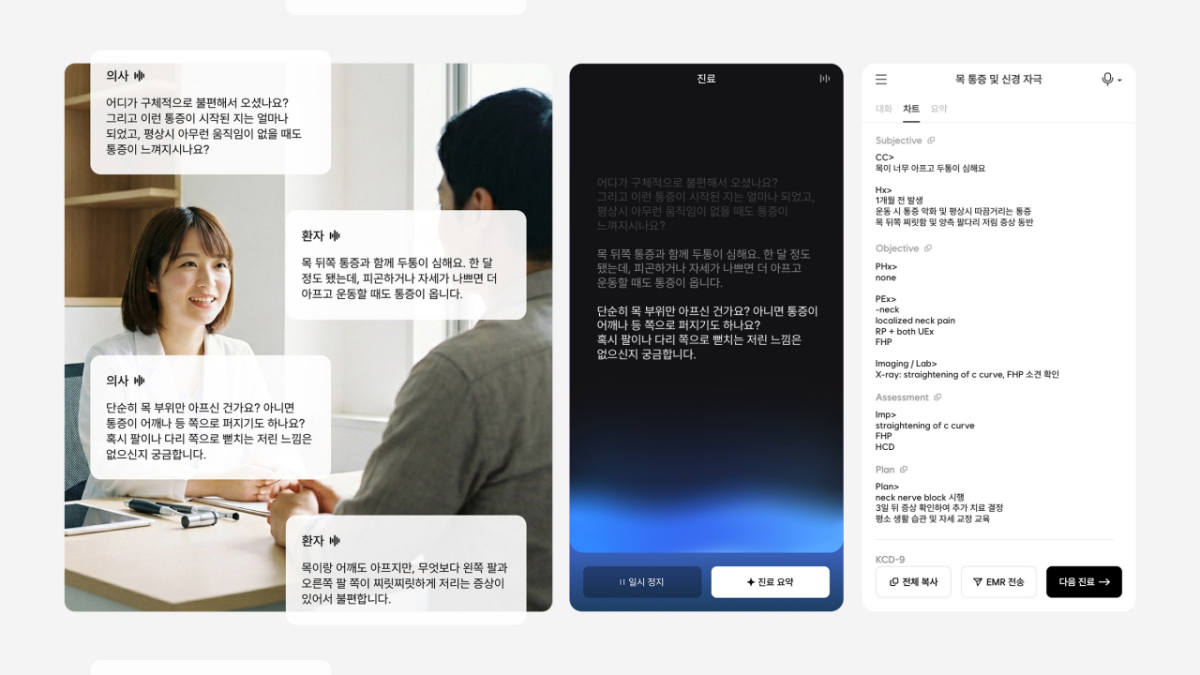
Studio Kiko (스튜디오키코) has raised a pre-Series A round from Smilegate Investment, Strong Ventures, and Korea Investment Accelerator for its ambient AI scribe Neardoc (니어닥), which generates completed SOAP charts within five seconds after a consultation. The tool, built on the company's proprietary Xynar (자이나) AI engine, uses multi-layer RAG and domain-specific training across 20+ departments with 17,000+ medical terms to achieve a clinician-editing rate of under 2%. Within two months of launch, Neardoc was adopted by more than 300 hospitals and clinics without paid marketing, reducing charting time by 70% and increasing patient throughput by 1.5x. The company now plans to develop a clinical decision support system (CDSS) and eventually an integrated medical OS.
Why it matters: This is a textbook case of the hyperscaler-distribution pattern playing out in healthcare — a purpose-built vertical AI tool achieving rapid bottom-up adoption through clinical pain-point relief rather than enterprise sales cycles. Ambient AI scribes are the fastest-growing category in medical AI, with the global market projected to grow from $6 billion in 2025 to $30 billion by 2033. Studio Kiko joins a cohort of companies worldwide vying to become the voice-first layer that sits between doctors and electronic medical records (EMRs), a position that accumulates high-frequency, high-signal clinical interaction data that could underpin the next generation of diagnostic and decision-support models. The founding team's pedigree — CEO Kim Se-hoon is a Wantedly (원티드랩) co-founder who led that company's IPO and global expansion — signals that product-led growth in healthcare AI can attract repeat-founding-track capital.
Expert take: The sub-2% correction rate on auto-generated charts is unusually strong for ambient scribes, which in the U.S. have reported correction rates of 5–15% depending on specialty and note complexity. Combining a purpose-built medical LLM, 360-degree microphone arrays, and real-time audio deletion for privacy compliance, Studio Kiko has addressed the core friction points that have kept earlier voice-to-text scribes from achieving clinician trust. The rapid penetration of 300 facilities without a sales force also suggests that the product experience itself is the distribution channel — a pattern we have previously seen in AI coding assistants and, more recently, AI note-takers for general business. The next test will be whether the company can extend from charting into diagnostic support and medical OS territory without losing the focus and execution speed that defined its initial traction.