Klassroom, an AI edtech company, has launched Klassroom Boost, a platform specifically designed to e...
The AMW Read
Incremental product launch in a known vertical; no new structural or capital signal; the competency-diagnosis angle is a modest update to existing edtech AI plays.

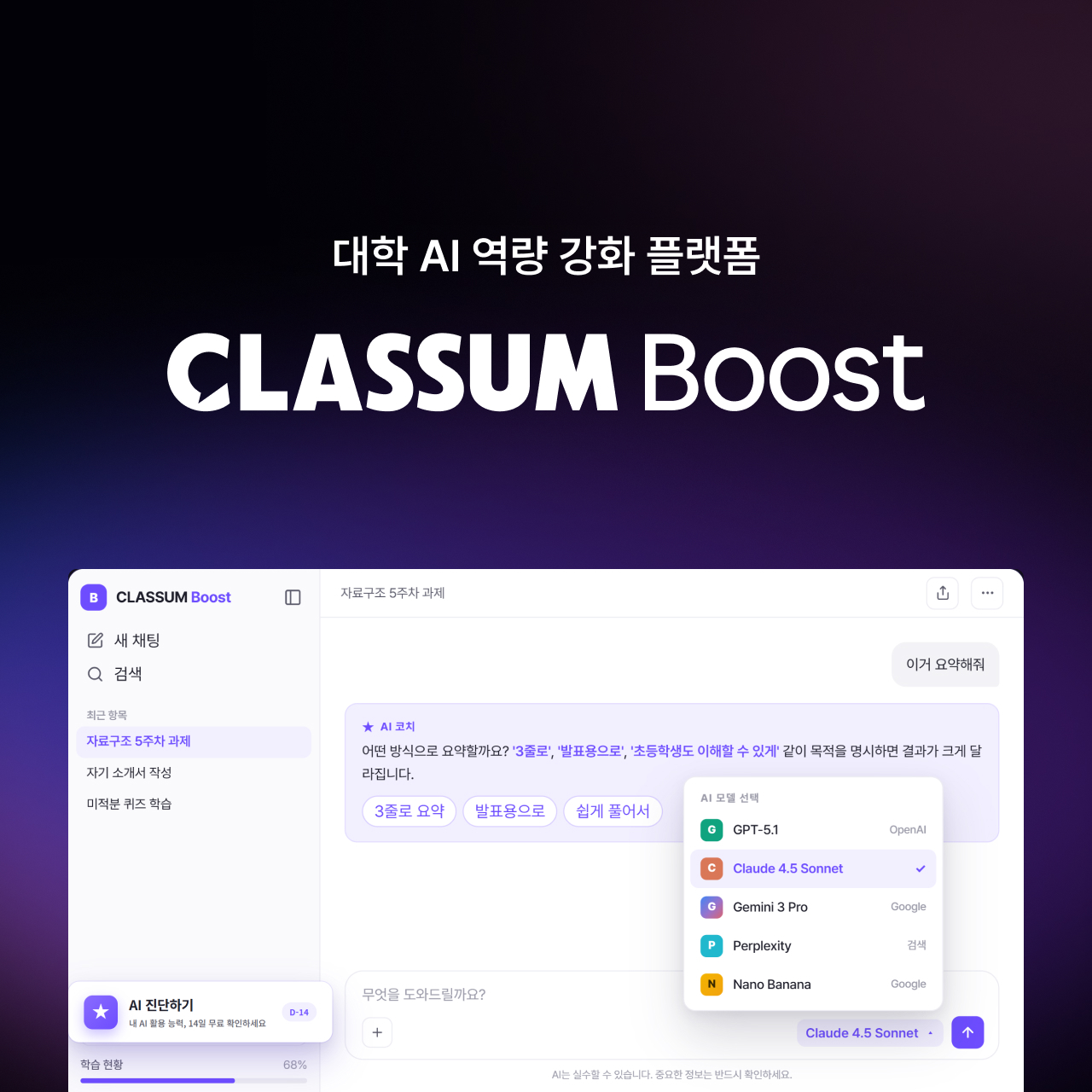
Klassroom, an AI edtech company, has launched Klassroom Boost, a platform specifically designed to enhance AI competency among university members—students, professors, and staff. Boost integrates ChatGPT, Claude, and Gemini into a single interface with unified login and credit-based management. The platform's core differentiator is its AI competency diagnostic tool, which measures skill across three areas: utilization planning (distinguishing tasks for human vs. AI), execution and interaction (structured prompt handling), and verification and decision-making (validating AI outputs). An 'AI Coach' feature offers real-time suggestions on more effective questioning and prompt techniques, aiming to reduce the usage gap between individuals. The platform is structured as a cycle: use, coaching, and diagnosis, enabling universities to track genuine competency improvement rather than just usage volume.
Why it matters: Klassroom Boost exemplifies a recurring pattern we track—the 'context-engineering moat' shifting from the enterprise to the education vertical. While most university deployments of generative AI have focused on access provision (e.g., ChatGPT campus licenses), Klassroom is tackling the harder problem of competency measurement and structured upskilling, which aligns with the 'framework builder' play in the enterprise AI substrate. This is an early validation that the AI coaching and diagnostic layer is becoming a distinct product category in vertical SaaS, mirroring patterns we've seen in legal and compliance AI (Segment 7) where assessment tools precede adoption.
The grounded take: Klassroom is a relatively small player in the Korean edtech ecosystem, and Boost's success will hinge on whether university IT departments buy into the competency-diagnosis paradigm versus treating AI as a commodity utility. The platform's integration of multiple frontier models (GPT, Claude, Gemini) without vendor lock-in is smart but also means the moat is in the assessment framework and coaching layer—not the AI itself. This is a textbook 'context-engineering' play adapted to higher education, an application layer bet that will need to prove its ROI in student outcomes before cross-segment scale.