Genspark claims 5,000 business customers as Japanese enterprises adopt AI workspace for time savings
The AMW Read
Incremental customer milestone for a known AI workspace player; but the cross-industry Japanese enterprise adoption and documented time savings are segment-level signals for AI agent adoption velocity.

Genspark claims 5,000 business customers as Japanese enterprises adopt AI workspace for time savings
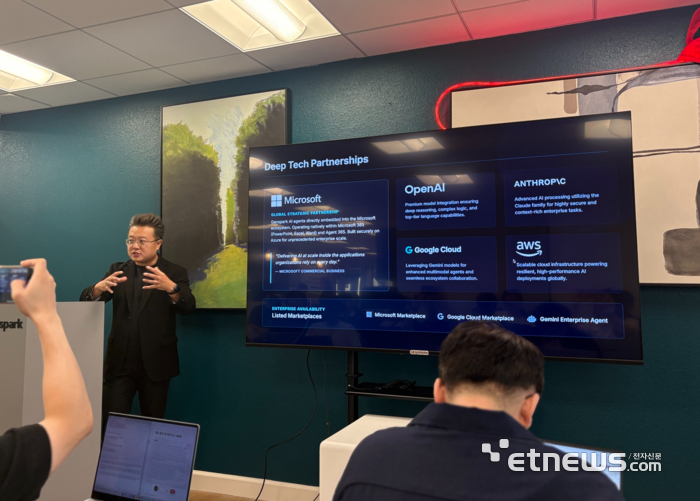
Genspark (ジェンスパーク), a Silicon Valley–born all-in-one AI workspace, has announced that its enterprise plan has surpassed 5,000 corporate customers globally, with notable Japanese adopters including Askul (アスクル), Dentsu (電通), Hankyu Hanshin Properties (阪急阪神不動産), Funai Soken (船井総合研究所), and Bell System 24 (ベルシステム24). Dentsu reported that teams using Genspark saved an average of 6 hours and 12 minutes per person per week within two months of adoption, equivalent to approximately 40 business days annually. Genspark integrates over 70 AI models including ChatGPT, Gemini, Claude, Sora, and ElevenLabs, offering a workspace where users issue natural-language requests that the system decomposes into tasks, selects optimal models, and executes autonomously via a feature called Genspark Claw.
The 5,000-customer milestone signals that the all-in-one AI workspace model is breaking out of the developer/tooling segment and penetrating mainstream enterprise operations across marketing, consulting, real estate, and customer-experience industries in Japan. This validates the pattern of 'context-engineering moat' — the observation that value concentrates not in any single model but in the orchestration layer that routes tasks to the best tool and manages governance, security, and cross-departmental deployment. The announced time savings at Dentsu and Funai Soken represent concrete, audited productivity gains that can accelerate enterprise AI adoption beyond pilot phases, especially in risk-averse Japanese corporate environments where compliance and security are gatekeepers.
Genspark is executing an enterprise-land-grab strategy that mirrors the playbook of earlier AI productivity suites, but with a critical twist: it bundles a proprietary agentic workflow layer (Genspark Claw) above the model marketplace. This hybrid approach puts it in direct competition with both broad AI assistants like Microsoft Copilot and specialized agents from companies like Adept AI. The fact that a relatively young company gained 5,000 paying business customers while integrating 70+ model providers suggests that enterprise buyers are signaling a preference for unified, governed environments over point solutions. The question now is whether Genspark can deepen its moat by adding vertical-specific workflows and data connectors before the hyperscaler distribution advantage of Microsoft, Google, or AWS overwhelms its lead in the mid-market.