AMD's Ryzen AI Embedded X100 targets robotics compute, challenging Nvidia Jetson's CPU bottleneck.
The AMW Read
AMD's Ryzen AI Embedded X100 and Kria AI SOM add a credible new silicon competitor targeting Nvidia Jetson's CPU bottleneck in robotics compute, backed by concrete CPU-bound control-loop benchmarks.
AMD's Ryzen AI Embedded X100 targets robotics compute, challenging Nvidia Jetson's CPU bottleneck.
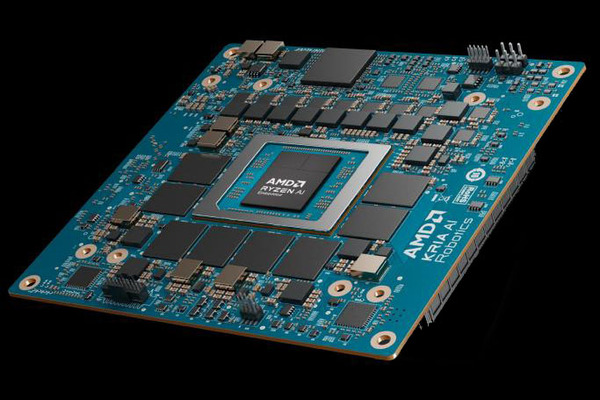
AMD introduced the Ryzen AI Embedded X100 series, an embedded derivative of its Ryzen AI Max platform, as the centerpiece of a new push into physical AI. The Embedded lineup rolled out in stages this year — P121/P132 in January, P164/P174/P185 in March, and X168/X188/X199 in July — but X100 is the first to pair a full Ryzen CPU and GPU with a 50 TOPS NPU at up to 120W, unlike the earlier P100 series, which shares the same NPU throughput but ships with fewer CPU/GPU cores at 15-54W and was not marketed around physical AI. AMD also unveiled Kria AI, a CPU-based system-on-module built on the Kria brand it inherited from Xilinx (previously FPGA-based Zynq UltraScale+ modules), plus a Robotics Development Platform pairing Kria AI with an FPGA I/O baseboard.
The positioning is aimed directly at Nvidia's Jetson family, which dominates embedded robotics compute but is GPU-heavy and CPU-light: even the top Jetson Thor T5000 (2,070 TOPS, up to 130W) runs a 14-core Neoverse-V3AE CPU at 2.6GHz, while Jetson Orin NX drops to eight Cortex-A78AE cores at 2GHz. AMD's argument is that physical AI control loops, which mix CPU logic with AI inference, bottleneck on Jetson's CPU rather than its AI throughput. Supporting benchmarks: a Bosch Rexroth industrial controller reimplemented on X100's CPU alone hit 8,000 decision loops per second, GPU inference for an existing robotics model ran 92ms against a 100ms requirement, and NPU vision classification finished under 0.4ms.
X100 is not sold as a standalone chip — like Ryzen AI Max, it ships with LPDDR5x soldered to the board — so Kria AI is effectively the only near-term way to design around it, unlike Jetson's established third-party board ecosystem. Robotics and industrial-automation teams now face a tradeoff between AMD's CPU-bound control performance and Nvidia's broader software stack and sourcing options.