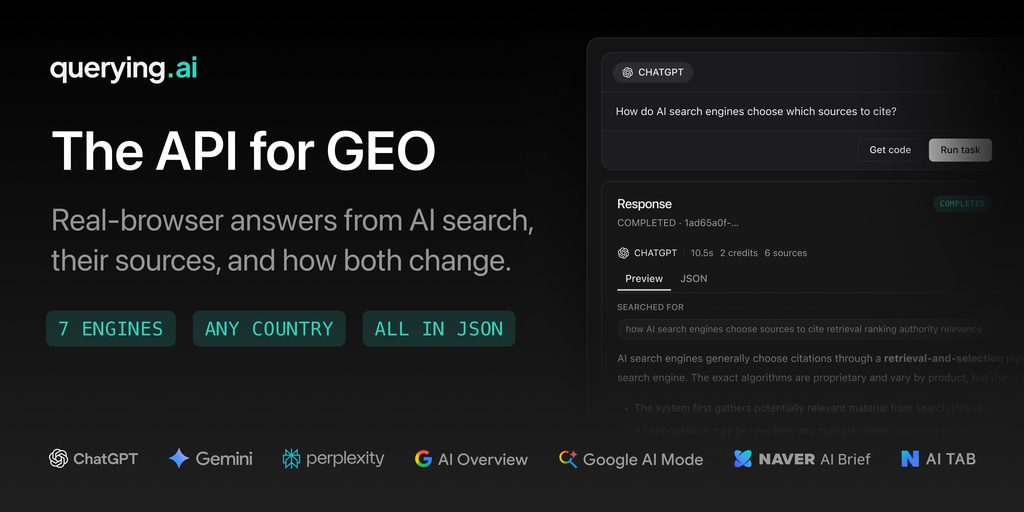
Animorph's querying.ai tracks how brands appear in AI search answers
The AMW Read
A new player introduces browser-scraped, on-screen data collection across multiple AI search surfaces as infrastructure for the emerging generative-engine-optimization category, a sub-segment-level product novelty rather than a structural or competitive shift.

Animorph's querying.ai tracks how brands appear in AI search answers
Animorph (애니모프), a Korean startup, has launched querying.ai, an API that collects the answers and cited sources shown on-screen in generative AI search tools. Rather than calling model providers' own APIs, the system automates a real browser to capture what a user actually sees, since Animorph says on-screen output can differ from raw API responses to the identical prompt. Clients submit a query along with a target service and country and get back the answer text, the underlying web searches the AI ran, its cited sources, and any product placements, each tagged with service, keyword, region and timestamp. Requests can be batched up to 500 per call, and the same query can be repeated hundreds of times a day to average out the answer variability built into generative systems and expose a trend rather than a single reading. Coverage spans ChatGPT, Google Gemini, Perplexity, Google AI Overview and AI Mode, and Naver's AI Briefing and AI Tab.
The product targets a fast-forming category sometimes called generative-engine optimization, where marketing and PR teams shift from tracking search-ranking position to tracking whether and how an AI answer cites their brand. Animorph is positioning itself as an infrastructure layer underneath that category — supplying the collection and monitoring data rather than the analytics dashboard itself — with GEO vendors, PR and marketing agencies, and large-company marketing teams as its stated customers.
For builders, the durability of this approach depends on providers tolerating repeated automated browsing of consumer-facing AI interfaces at volume, an assumption that could be disrupted by rate-limiting or interface changes. For investors evaluating the emerging GEO tooling stack, the more defensible layer may be the one owning multi-surface, region-aware collection infrastructure rather than the reporting layer built on top of it.