Arinko (ありんこ) ships Anthole, a PC-only AI knowledge assistant with no cloud dependency
The AMW Read
A new entrant ships a fully offline, on-device document-retrieval product for security-constrained government, healthcare, and legal buyers, an incremental addition to the local-first data-infrastructure niche rather than a segment-shifting event.
Arinko (ありんこ) ships Anthole, a PC-only AI knowledge assistant with no cloud dependency
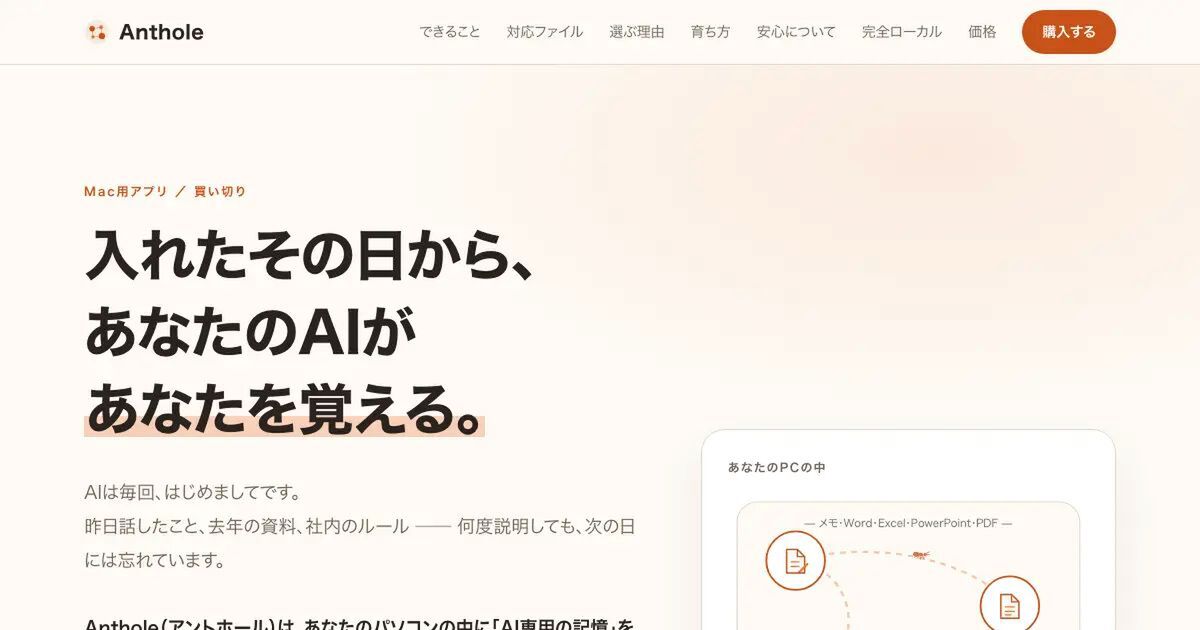
Arinko, a Japan-based startup (株式会社ありんこ), began selling its Anthole knowledge app on August 18 for a one-time fee of 12,800 yen (~$87), running on macOS and Windows 11. The software bundles the AI model and all runtime dependencies locally, ingests Word, Excel, PowerPoint, PDF, and Markdown files via drag-and-drop, and performs both storage and search entirely on-device, with no path to send data externally — it can operate fully disconnected from any network. It also auto-configures integration with existing AI apps like ChatGPT and Claude, removing the need to hand-edit config files or set up a separate Python environment.
The product targets government agencies, healthcare providers, and legal offices that cannot send documents to cloud AI services under confidentiality requirements, a constraint that has kept many regulated buyers out of mainstream RAG and knowledge-management tools built around cloud vector databases. By packaging retrieval and inference to run entirely on a single machine, Anthole treats the PC itself as the full knowledge-management stack rather than a client to a hosted service — a bet that local models and on-device search are now capable enough for practical document Q&A without server-side infrastructure.
At $87 as a one-time purchase, the economics resemble packaged software more than SaaS. For builders, it's a proof point that offline document retrieval is productizable at consumer price points for security-constrained buyers; for investors, the defensibility is narrow and depends on staying ahead of larger enterprise knowledge-tool vendors that could add a local-only mode of their own.

