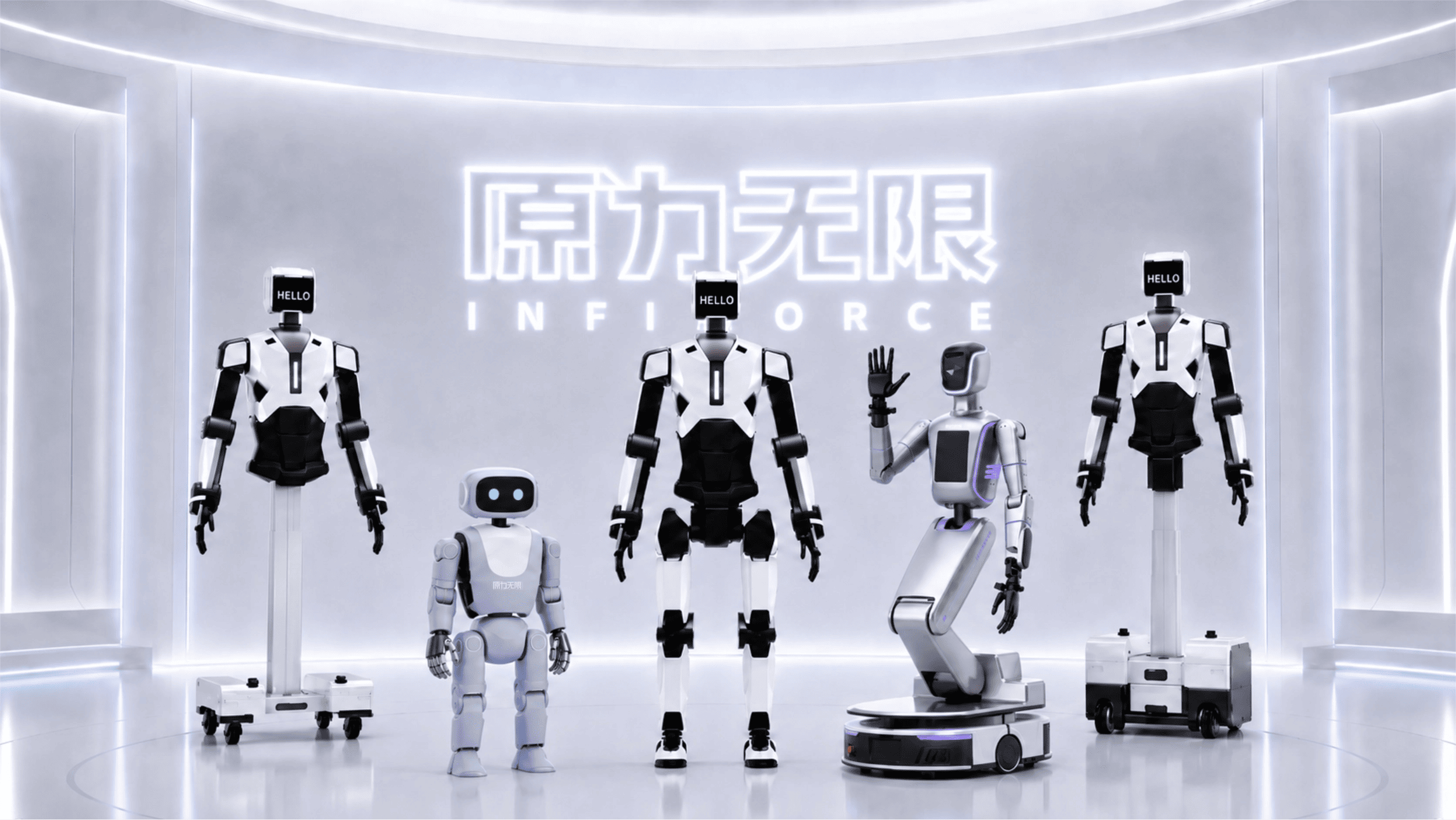
Infiforce has raised nearly $150 million across Series A and Series A+ rounds to develop embodied-AI...
The AMW Read
The funding updates the robotics segment player map, but the ego-data approach and state-backed capital add incremental novelty while positioning Infiforce as a segment-level contender.

Infiforce has raised nearly $150 million across Series A and Series A+ rounds to develop embodied-AI models and expand robot deployments in industrial and commercial settings. The funding, led by Dunhong Asset Management and state-owned investment platforms, also includes participation from Zhejiang University Science and Technology Innovation Group and existing shareholder Genesis Partners Venture Capital. Infiforce plans to use the capital to advance its AtomBrain embodied-intelligence system, expand its DataGrid data infrastructure, and scale deployments of its AstroDroid, UltraDroid, and Little Atom robots across more than 30 Chinese cities and over 100 scenarios.
The company's core differentiator is its "Ego" data approach — using first-person recordings of human interactions with the physical world to train its world models, rather than relying solely on third-person demonstrations or teleoperation data. This method aims to lower data-collection costs while scaling training data volume. Infiforce reports strong benchmark results on models like AtomVLA and HiMem-WAM, with success rates above 97% on the Libero benchmark, though these are company-reported figures. The DataGrid infrastructure creates a feedback loop where real-world robot deployments generate data for subsequent model training, and the company is testing whether its intelligence can transfer across different robot hardware form factors.
For investors and builders, Infiforce's funding round signals a structural shift in embodied AI toward first-person data pipelines and causal world models as the next competitive frontier beyond traditional teleoperation-based approaches. This capital will enable Infiforce to deepen its moat around data collection infrastructure and cross-hardware generalization, potentially positioning it as a key player in the physical AI market alongside peers building robot-specific foundation models. The involvement of state-owned investors also highlights China's strategic push to dominate embodied AI, which could accelerate standardization efforts—Infiforce already participates in a national specification for crowdsourced embodied-intelligence data collection.