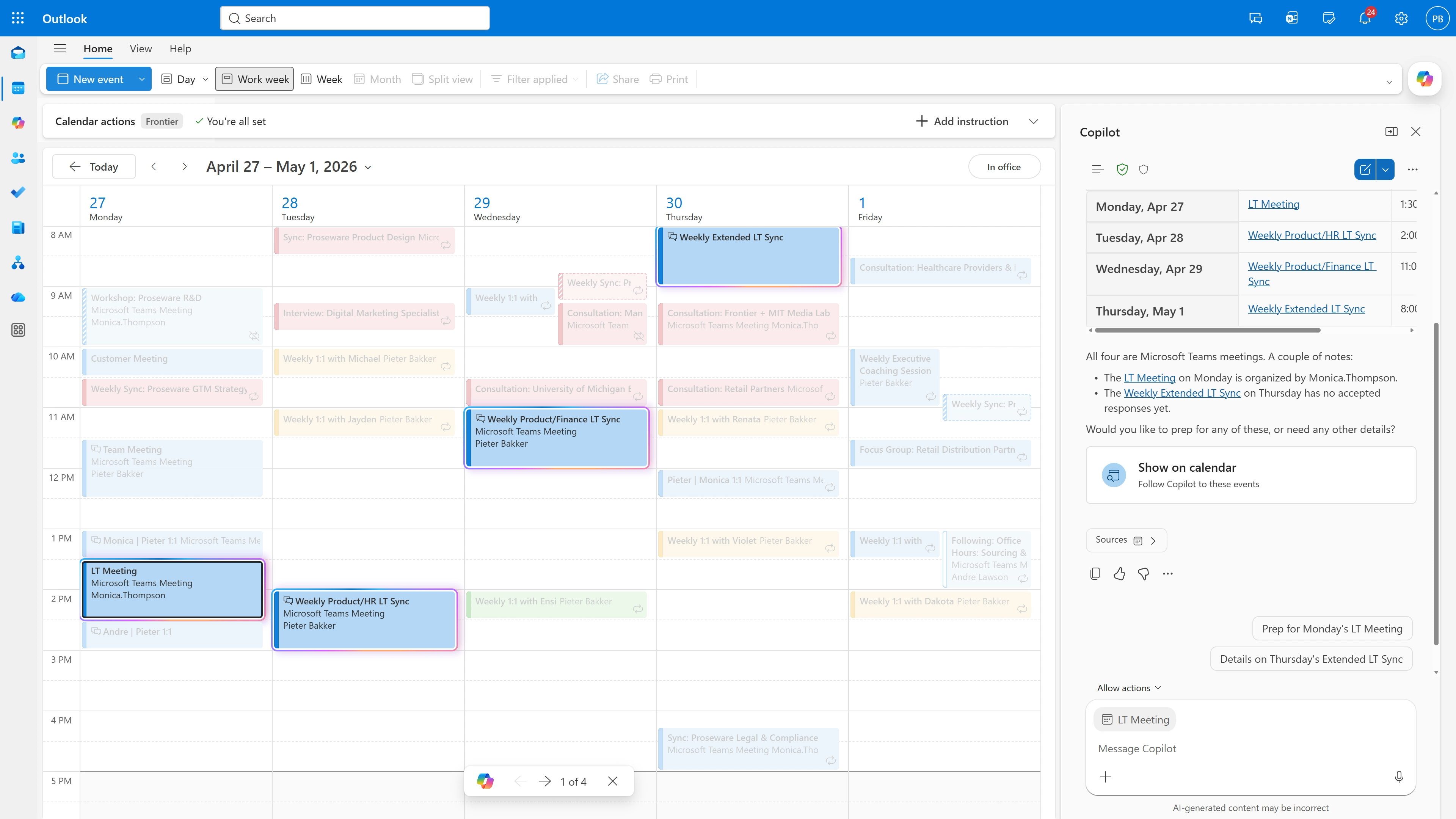
Microsoft Copilot in Outlook becomes agentic, triaging emails and rescheduling calendar conflicts
The AMW Read
Incremental feature update to an existing product (Copilot), but the agentic scope and distribution leverage are segment-level significant for enterprise AI agents.
Microsoft Copilot in Outlook becomes agentic, triaging emails and rescheduling calendar conflicts
Microsoft announced that Copilot in Outlook is now agentic, moving beyond drafting emails to autonomously managing inboxes and calendars. New features include proactive follow-up detection, email prioritization, inbox-rule creation, calendar conflict resolution, meeting rescheduling, and priority-based time alignment. The update, released April 27 in a Frontier early-access program, lets Copilot perform multi-step tasks like drafting follow-ups for unanswered emails, rescheduling 1:1 meetings when conflicts arise, and recommending which meetings to decline or convert to async.
Why it matters: This rollout exemplifies the hyperscaler-distribution pattern—Microsoft is embedding agentic capabilities directly into the world's most widely deployed productivity suite, bypassing the need for standalone agent startups to build distribution. It also updates the open debate around whether agentic AI will be won by incumbents with existing user interfaces and data gravity, or by pure-play agent platforms. By making Outlook the agentic layer for email and calendar, Microsoft leverages its consumer and enterprise OS-level integration to turn a passive tool into an always-on background worker, potentially raising the bar for all email and calendar competitors.
Expert take: The move signals that Microsoft sees agentic AI not as a separate product category, but as a feature set within its Office monopoly—a strategy that could compress the market for standalone email-assistant startups. The Frontier program's controlled rollout suggests Microsoft is still iterating on reliability, but the scope of delegated scheduling and triage represents a meaningful step toward calendar-as-a-service. If this feature achieves widespread adoption, it could entrench Microsoft's position in the enterprise productivity stack and make it harder for competitors to differentiate on inbox management alone.


