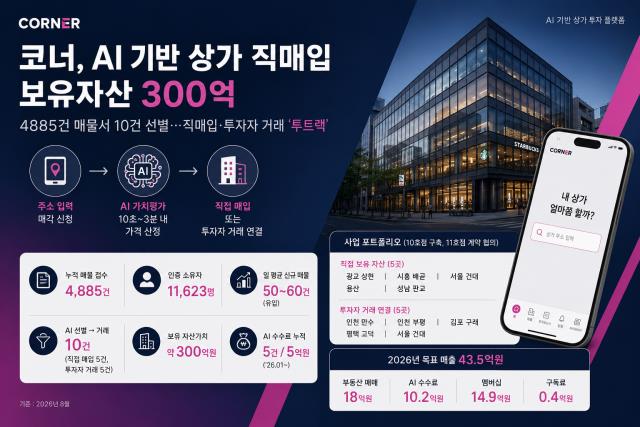
Corner (코너) is directly acquiring commercial retail real estate using AI-based valuation, expanding...
The AMW Read
A small Korean startup applying AI sourcing to direct principal investment in commercial real estate is an incremental new-entrant update with narrow, sub-segment-only impact.

Corner (코너) is directly acquiring commercial retail real estate using AI-based valuation, expanding its held portfolio to 30 billion won (~$22M) in assets.
The Seoul-based startup uses AI to identify undervalued commercial retail spaces (상가) in dense urban submarkets, then deploys its own capital to acquire and operate the properties rather than simply listing valuation data for third parties. The company has closed contracts on 10 properties to date, concentrated in Seoul's Konkuk University and Yongsan districts and in Pangyo, Seongnam. Its stated model combines two revenue tracks: ongoing platform/operating income from the properties and trading-margin profit realized on acquisition and eventual resale.
This places Corner in a narrower and riskier lane than most AI real-estate tooling: rather than selling an AI valuation signal to brokers, landlords, or asset managers as a subscription product, it takes the signal onto its own balance sheet as principal capital. That shifts the operative constraint from model accuracy alone to capital access and the ability to carry illiquid physical assets through a holding period — a structurally different bet than a SaaS-style vertical AI company serving real estate operators, and one where AI is a sourcing edge rather than the entire product.
For investors or builders evaluating this model, the relevant diligence is less about the AI's property-picking accuracy and more about the underlying capital structure: what's funding the 30 billion won in holdings, what leverage or co-investment sits behind each of the 10 properties, and how liquid an exit looks if the trading-margin thesis on any single asset doesn't play out. Direct-acquisition proptech scales with balance-sheet capacity, not just model quality — a different growth ceiling than tooling vendors face.