Databricks commits $300M to ANZ expansion, opens Sydney HQ amid 85% Q1 growth
The AMW Read
Incremental update to a known player's regional expansion (novelty 1), but the 85% growth rate and focus on agentic data infrastructure carry segment-level significance for data infrastructure competitive dynamics (significance 2).

Databricks commits $300M to ANZ expansion, opens Sydney HQ amid 85% Q1 growth
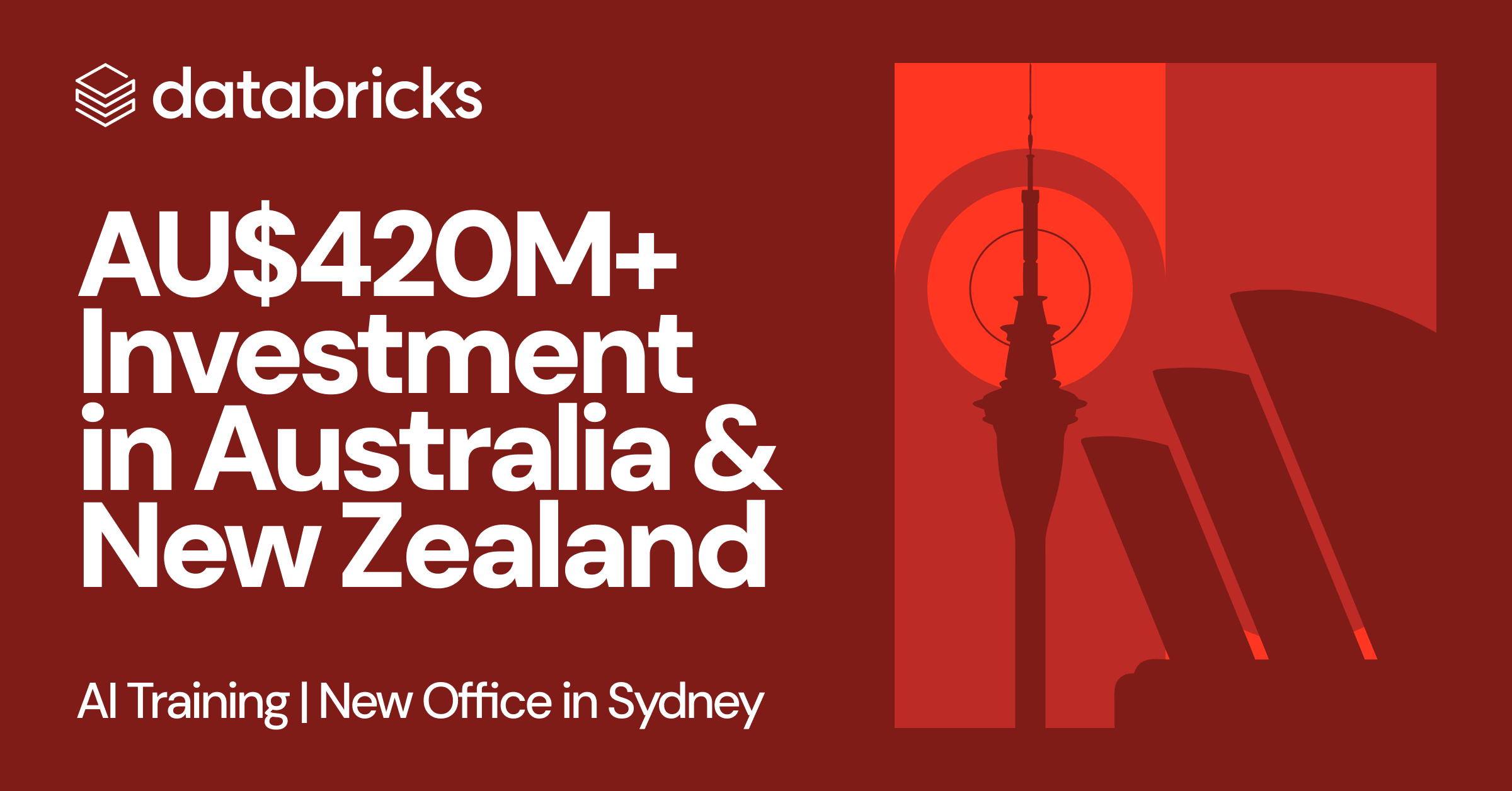
Databricks announced a US$300 million (AU$420 million) investment in Australia and New Zealand over three years, including a new 22,000-square-foot headquarters at 400 George Street in Sydney. The company reported 85% year-on-year growth in Q1 2026 across the region, with customers including City of Melbourne, National Australia Bank, Telstra, and Queensland Health. The investment will also upskill 100,000 learners in data and AI and drive adoption of Lakebase, Genie, and Agent Bricks.
Why it matters: This commitment extends the hyperscaler-distribution pattern—Databricks is deepening its regional foothold by pairing infrastructure investment (physical office, training programs) with product expansion (serverless Postgres database, natural-language AI agent, and agent-building platform). The 85% growth figure signals that enterprise AI adoption in ANZ is shifting from experimentation to production, a recurring pattern observed across other segments where incumbents use capital deployment to lock in regional customer bases before competitors establish equivalent on-the-ground presence.
From a substrate perspective, the investment updates the capital-compression arc: Databricks chooses to reinvest revenue growth into market expansion rather than return capital, consistent with its strategy of becoming the default data-and-AI platform for enterprises. The specific emphasis on Lakebase (Postgres for agents) and Genie (chat-with-data agent) indicates Databricks is building a moat that combines data infrastructure with agentic AI capabilities—a structural force that could redefine how enterprises deploy LLMs against proprietary datasets. No new valuation or funding round is disclosed, so this is not a capital-cycle event; rather, it is an operational investment signal.