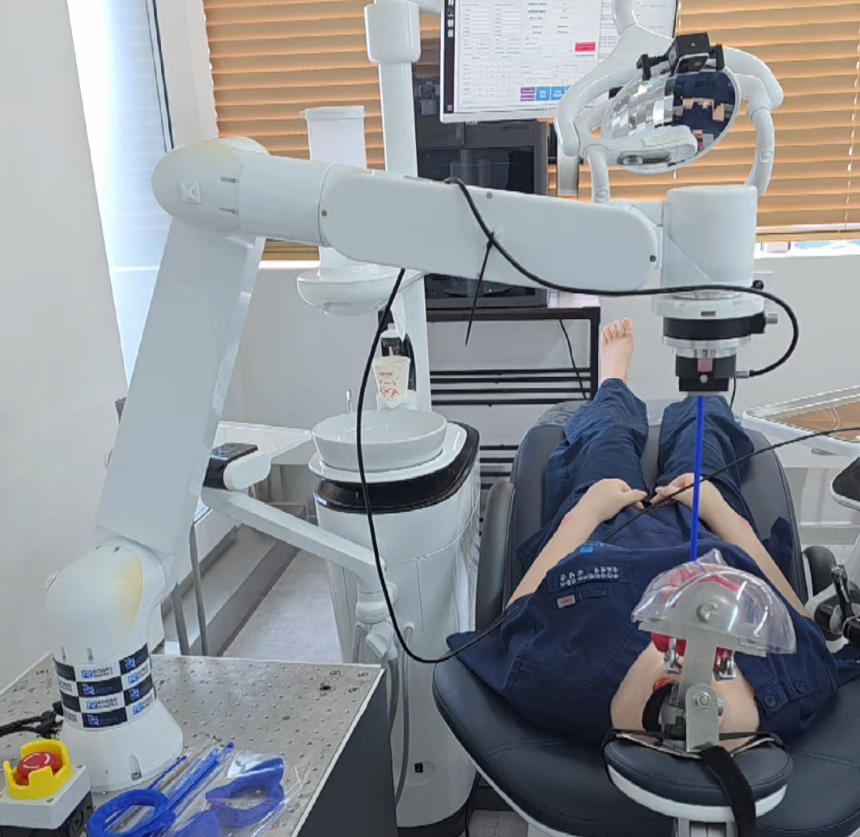
Dental Robotics raises seed funding for an AI-powered dental suction robot, led by AI Angel Club.
The AMW Read
New seed-stage entrant applying vision-guided robotics to a narrow, well-instrumented dental task, with undisclosed funding and sub-segment-only downstream impact.

Dental Robotics raises seed funding for an AI-powered dental suction robot, led by AI Angel Club.
South Korea's Dental Robotics closed a seed round led by AI Angel Club, with participation from CNT Tech, People Investment, and Digital Healthcare Partners; the amount was not disclosed. The company's robot automates suction of saliva and blood during dental procedures, a task that internal analysis shows consumes roughly 2.5 hours of a dental hygienist's day, about 2 hours of it unassisted. The system fuses dental CT and intraoral scanner data into a patient-specific 3D coordinate map, then uses real-time vision AI to distinguish saliva, blood, teeth, and gum tissue so a robotic arm can locate and perform suction on its own; a pressure sensor at the tip provides tactile feedback, backed by layered hardware and software safety checks. First shown publicly at the SIDEX 2026 dental exhibition in Seoul, the device is now in safety and efficacy testing with the oral and maxillofacial surgery team at Korea University Anam Hospital. Dental Robotics has filed 20 patents, with 4 granted, and is targeting Korean Class 2 medical device clearance, followed by digital medical device and overseas certification, ahead of a planned 2028 commercial launch. The company is led by oral-maxillofacial surgeon Kim Nam-gyun, who also runs Yonsei Good Plant Dental Clinic, and co-CEO Eom Se-hyun, who oversees AI digital-twin and 3D development, with engineers drawn from Medipixel, Rainbow Robotics, Huvitz, and Osstem Implant.
The pitch reframes physical AI's near-term medical opening: rather than chasing general surgical autonomy, Dental Robotics targets a narrow, repetitive assistive task in an environment already instrumented with CT and intraoral-scanner data, which makes spatial mapping tractable today. That logic — pick a procedural chore with existing 3D ground truth rather than an open-ended surgical role — is a more realistic entry point for embodied AI into regulated clinical settings than headline-grabbing autonomous-surgery claims.
For builders and investors in medical robotics, the signal is that go-to-market discipline (single-task automation, a hybrid hardware/software-subscription/consumables pricing model, and staged domestic-then-export regulatory sequencing) matters more than round size, which here is undisclosed. The multi-year runway to a 2028 launch, gated by Class 2 device clearance and hospital-run clinical validation, underscores that patent position and clinical partnerships — not funding alone — are the moat to track in this niche.