Kakao open-sources four lightweight on-device SLMs on Hugging Face, advances Korean-language efficiency
The AMW Read
Incremental update to a known segment player; Korean-language tokenizer optimization is notable but sub-segment in impact.
Kakao open-sources four lightweight on-device SLMs on Hugging Face, advances Korean-language efficiency
Kakao (카카오) has released four small language models (SLMs) on Hugging Face — Kanana-2-1.3B-base, Kanana-2-1.3B-instruct, Kanana-2-3B-base, and Kanana-2-3B-instruct — under the Kanana Open License which permits commercial use. The models are optimized for on-device deployment on smartphones and PCs, with a custom Korean-language tokenizer that cuts Korean text processing compute by over 30% compared to prior approaches. A sliding-window attention mechanism reduces memory consumption by up to 72.7% for conversations of up to 32,000 tokens, enabling sustained performance on resource-constrained hardware.
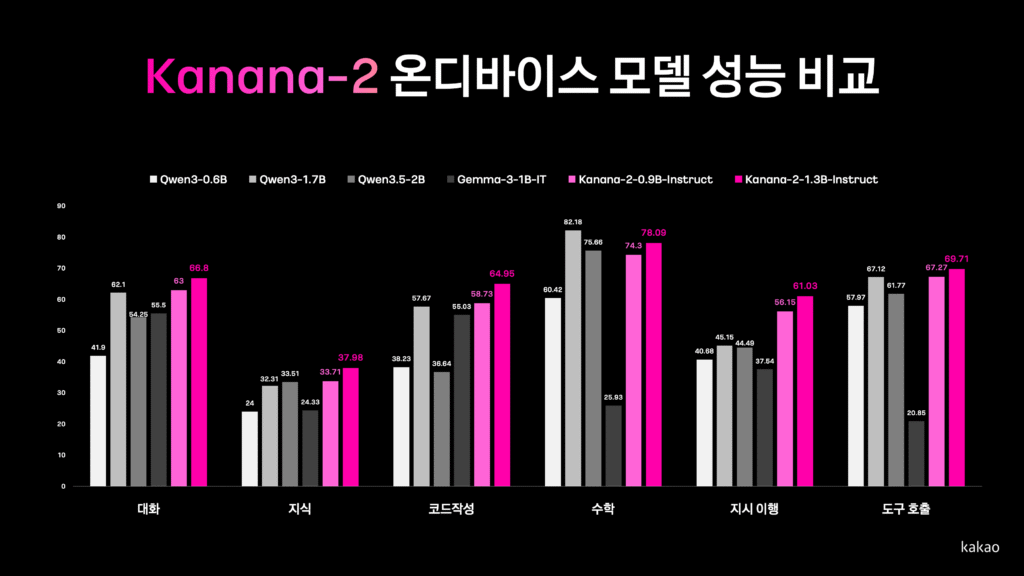
Why it matters: Kakao's open-source play fits the acquire-developer-distribution pattern that has become the dominant go-to-market strategy for foundation-model labs outside the top frontier tier. By releasing competitive SLMs (benchmark results matching Qwen and Gemma at comparable sizes in Korean dialogue, knowledge, math, code, instruction-following, and tool-calling) under a permissive license, Kakao is attempting to seed an ecosystem around its Kanana line — the same playbook that DeepSeek, Mistral, and Qwen have used to gain adoption against closed-weight incumbents. The Korean-language tokenizer efficiency improvement is a structural advantage for any service targeting the domestic market: fewer tokens per sentence directly lowers inference cost and latency on device.
Grounding in our substrate: Kakao's current on-device SLM deployments — in KakaoTalk conversation summarization, call summaries, and the AI Gukminbiseo (digital assistant) service — provide a real-world proving ground that most open-weight model publishers lack. The company claims competitive results against Qwen and Gemma in Korean tasks, suggesting that localized tokenizer optimization may create a meaningful performance gap that general-purpose multilingual models cannot close without retraining their tokenizer. This could reinforce the regional-language moat dynamic where hyper-local efficiency improvements become defensible barriers for domestic players, particularly in compute-constrained on-device environments.