Naver launches conversational search 'AI Tab' with its next-generation LLM
The AMW Read
Naver's integration of a custom LLM into its core search product at national-scale (50M users) updates the agentic-search player map with a hyperscaler-distribution move, advancing the Korean search-AI competitive baseline.
Naver launches conversational search 'AI Tab' with its next-generation LLM
Naver has formally launched its generative AI-powered conversational search service, 'AI Tab', to all 50 million Korean users after a two-month beta reserved for Naver Plus members. The beta amassed 4 million cumulative users in roughly two months, with click-through rates on product and place cards exceeding 20%. The full release is accompanied by a production-native LLM, designed specifically for Naver's service ecosystem — a 'product-native LLM' optimized for speed and throughput at scale.
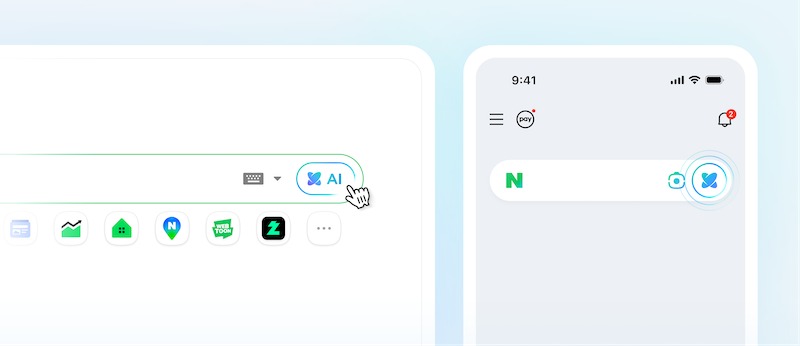
This launch is a textbook case of the hyperscaler-distribution moat: Naver is deploying its own foundational-model technology directly into the highest-traffic search entry point in South Korea, matching a playbook already executed by Google (Search Generative Experience) and Baidu (ERNIE Bot). The AI Tab is not a separate app — it lives inside the existing search bar, meaning every search query becomes a potential agentic conversation. Naver is also folding its multimodal tool (Smart Lens) and music search into the tab, and plans to extend AI Tab to its Whale browser by year-end.
Grounded expert take: Naver's 'product-native LLM' framing is a deliberate structural move. Rather than competing in the general-purpose frontier-model race, Naver is betting on a bespoke model tailored to its verticals — shopping, local search, real estate, health. The early user-behavior data (AI Tab heavy-users click 2.7x more product links) suggests this isn't just a feature play; it's a conversion engine. The key open question, which this launch does not yet answer, is whether Naver can sustain engagement without the multi-turn conversational depth of a frontier reasoning model, and whether its proprietary Korean-language data moat is sufficient to keep global rivals at bay.