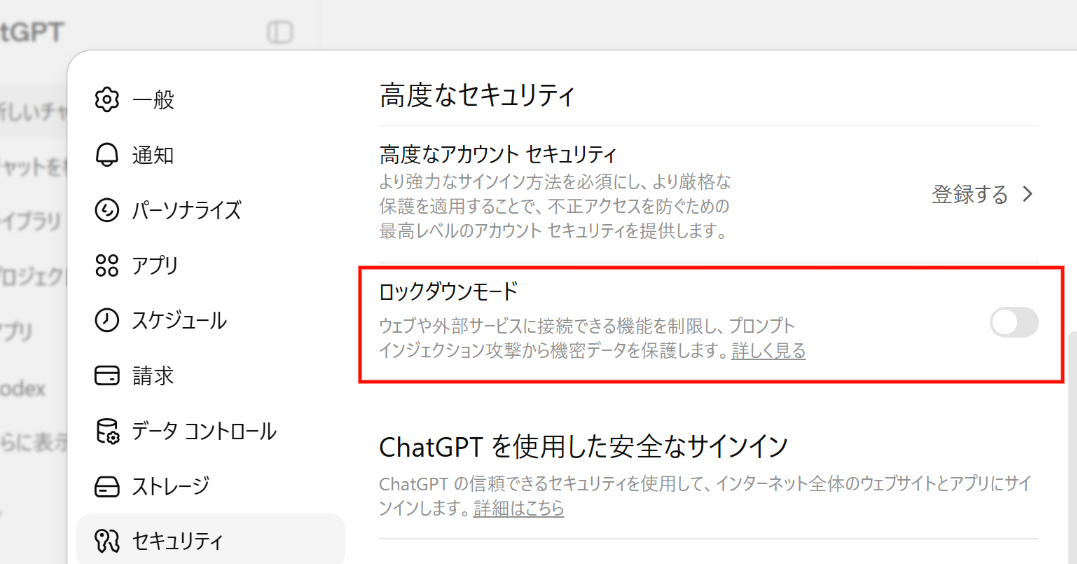
OpenAI launches Lockdown Mode for ChatGPT to prevent prompt injection attacks.
The AMW Read
Incremental product feature for a dominant platform player; segment-level significance as it formalizes a security tier for enterprise adoption but does not change competitive landscape or resolve an open debate.

OpenAI launches Lockdown Mode for ChatGPT to prevent prompt injection attacks.
On June 5, 2026, OpenAI began rolling out a new security feature called Lockdown Mode for ChatGPT. The setting is designed to mitigate data exfiltration risks from prompt injection attacks by restricting ChatGPT's ability to connect to external web services and third-party APIs. When enabled, features like live web browsing (cached content only), image display and retrieval, Deep Research, Agent Mode, Canvas network access, and external file uploads for data analysis are disabled or limited. The feature is available on Free, Go, Plus, Pro, Business, and Enterprise accounts, and can be toggled by individual users under Settings > Security > Advanced Security. OpenAI emphasizes the mode significantly reduces but does not eliminate exfiltration risk.
Why it matters: This release updates the recurring Security-Utility Tradeoff pattern seen across enterprise AI platforms. Lockdown Mode is a defensive product response to the structural force of adversarial prompt injection — a class of attack that has been an open production risk since the early days of LLM-integrated workflows. By sacrificing agentic capabilities (browsing, deep research, file uploads) for data containment, OpenAI is effectively offering a tiered trust model: the same model, but with a locked-down execution environment for sensitive-data use cases. This signals that the enterprise deployment bottleneck is shifting from model capability to secure integration — a pattern that may pressure competitors like Anthropic and Google to match with their own containment modes, potentially segmenting the AI assistant market into 'open-web' and 'sandboxed' tiers.
Industry watchers should note that Lockdown Mode does not protect against model-level prompt injection that manipulates the model's internal reasoning — it only blocks network-level exfiltration channels. This distinction means the feature is a tactical fix, not a structural solution to the broader injection taxonomy. Enterprises handling regulated data (finance, healthcare, legal) will need to evaluate whether network restriction alone meets their compliance bar, or whether they require full isolation like on-premise deployment or closed-model architectures.

