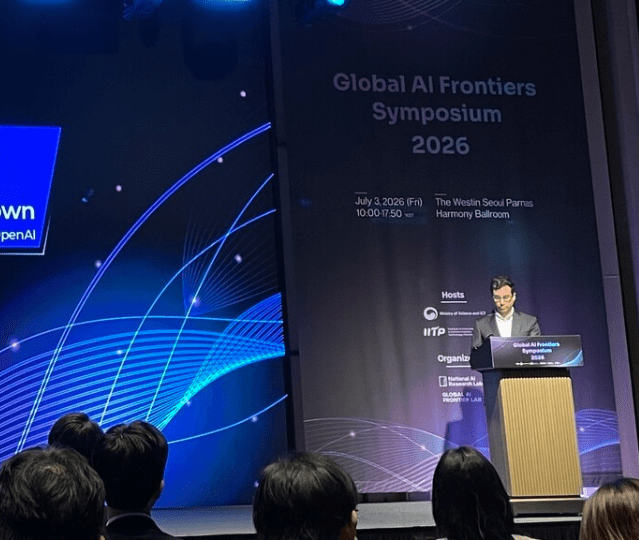
OpenAI VP argues for test-time compute as new evaluation standard, replacing single benchmark scores
The AMW Read
Novelty 2: Brown's argument meaningfully advances the test-time compute debate within known OpenAI strategy. Significance 2: Reframes benchmark methodology and safety vetting, impacting segment-level evaluation norms for all frontier labs.
OpenAI VP argues for test-time compute as new evaluation standard, replacing single benchmark scores
Noam Brown, OpenAI's VP of Research, used a keynote at the Global AI Frontier Symposium 2026 in Seoul to argue that the AI industry must move beyond single benchmark scores for evaluating frontier models and adopt a test-time compute (inference-stage computation) measurement framework. Brown directly addressed the recent performance controversy surrounding GPT-5.5, stating that while benchmark scores show minimal improvement over GPT-5, allocating additional tokens and time at inference yields substantially higher real-world performance — a property masked by static benchmarks. He proposed that labs should publish performance-vs-cost graphs (y-axis: performance, x-axis: compute/time invested) rather than single scores, and that independent evaluators should precisely measure the compute and latency used in producing responses.
Why it matters: Brown's argument updates the Scaling Law debate (cross.§B) by asserting that the frontier of model capability is no longer solely about pre-training compute, but about inference-stage compute budgets — a paradigm shift that directly affects how labs compete, how buyers evaluate models, and how regulators assess safety. The proposal effectively reframes the context-engineering moat (Segment 01, §5.4) as a test-time compute moat: labs that can deliver high-quality reasoning under variable compute budgets will dominate enterprise and high-stakes use cases. Brown's call for transparent performance-vs-compute curves also addresses a long-standing critique of opaque benchmark claims, potentially reshaping the disclosure norms for frontier labs.
The multi-agent architecture Brown offered as a pragmatic solution — splitting reasoning across agents to reduce latency and token costs — is a notable directional signal. It suggests OpenAI sees agent orchestration as the practical bridge between expensive single-model test-time compute and real-time user expectations. For AI safety regulators, Brown's warning that current infrastructure is inadequate to vet large-scale test-time compute attack surfaces introduces a new dimension to the safety debate: not just what models can do, but what they can be induced to do with extended inference budgets.
#OpenAI #TestTimeCompute #AIEvaluation #FrontierModels #InferenceEconomics #MultiAgentSystems
