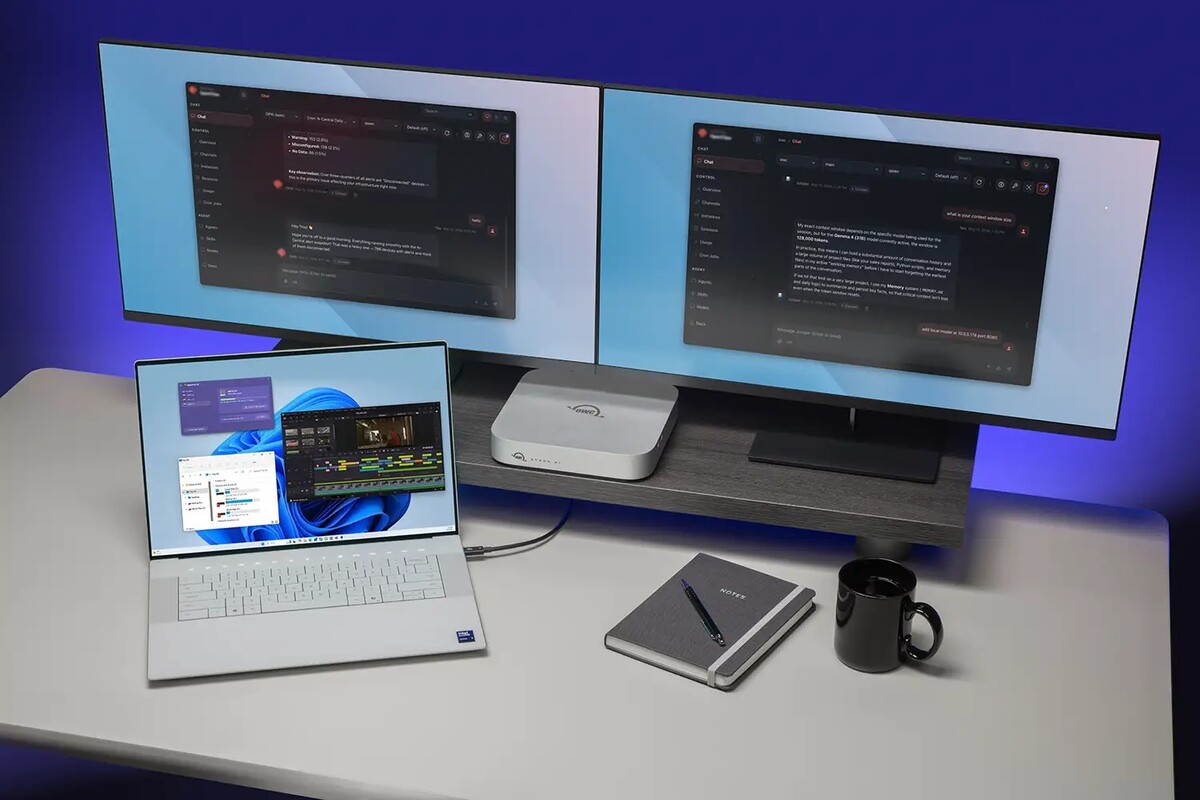
OWC launches Thunderbolt 5 AI accelerator for local LLM inference
The AMW Read
A new hardware category within AI infrastructure (external memory-based accelerator) is novel for the segment, but the product is unproven and targets a niche use case, limiting immediate cross-segment impact.

OWC launches Thunderbolt 5 AI accelerator for local LLM inference
OWC (Other World Computing) announced the OWC Stack AI, a Thunderbolt 5 AI accelerator and storage hub that extends the working memory of existing PCs and notebooks to run large-scale AI models locally. The device, slated for release later in 2026, eliminates the need to send data to the cloud, promising cost savings, improved privacy, and security. CEO Larry O'Connor framed the product as solving the forced choice between expensive cloud usage and hardware memory limits.
Why it matters: This fits the 'context-engineering moat' pattern, where local inference hardware shifts the compute burden from hyperscaler GPU rental to desktop-class memory expansion. OWC is not a model lab but a hardware peripheral vendor — its entry signals that the AI inference substrate is broadening beyond GPU farms into consumer/prosumer peripherals. The Thunderbolt 5 interface (80 Gbps bi-directional) enables this, but the product's success depends on whether enterprises and researchers will trust external memory modules for model serving vs. dedicated GPU VRAM or cloud instances.
Grounded take: OWC has zero presence in the foundation-model or AI-infrastructure segment today. This launch is a bet that the 'local inference' thesis — championed by Apple's unified memory and NPU, and by ONNX runtime optimizations — extends to third-party PCIe/TB5 peripherals. The product competes not with NVIDIA or AMD but with the general-purpose memory ceiling on MacBooks and PC workstations. If it gains traction, it updates the hardware economics of §4 (e.g. Mistral's local-first strategy) but does not alter the hyperscaler dominance of model training or inference-as-a-service. The risk: Thunderbolt 5 bandwidth, while fast, still bottlenecks at ~6 GB/s vs. GPU local bandwidths of >1 TB/s — bandwidth asymmetry may limit supported model sizes to <34B-parameter range.