SiMa.ai launches Palette Neat agentic development platform for physical AI applications
The AMW Read
SiMa.ai enters physical AI hardware with a novel pin-compatible, low-power SoM and agentic platform, updating the segment player map with a credible alternative to NVIDIA's dominance.

SiMa.ai launches Palette Neat agentic development platform for physical AI applications
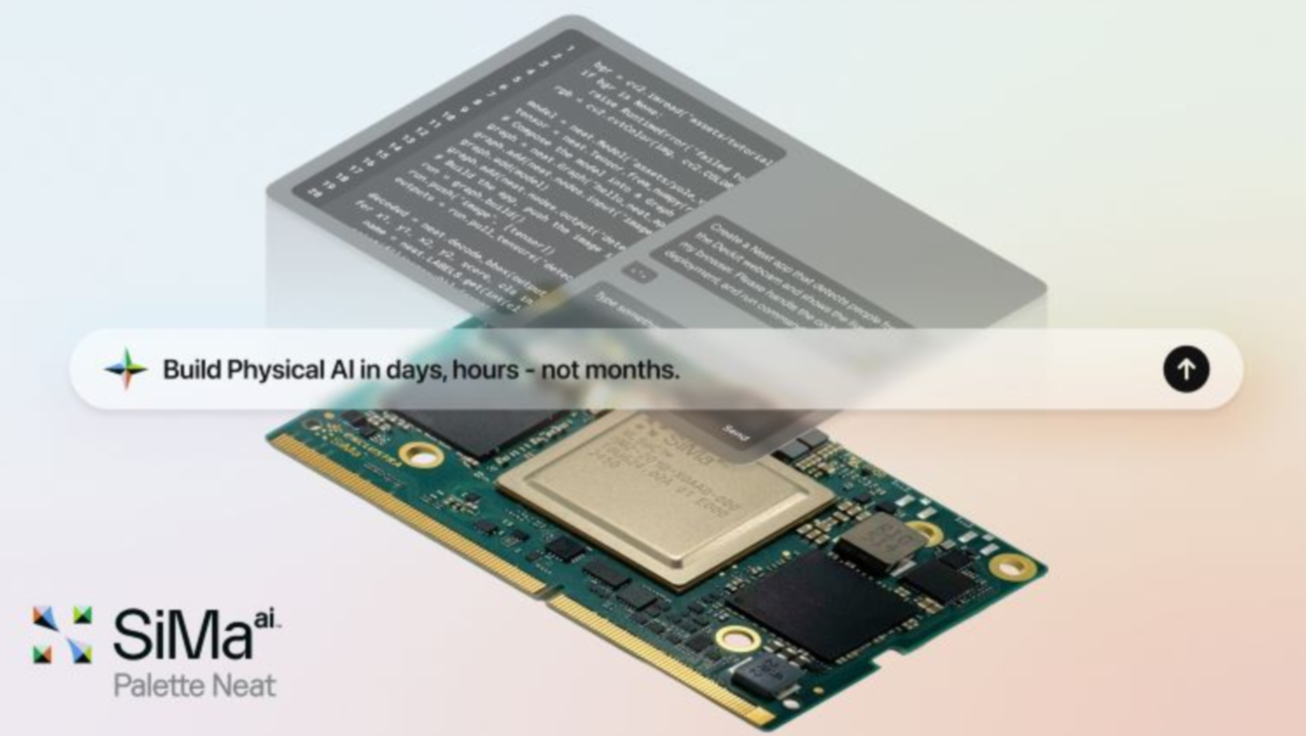
SiMa.ai, a physical AI semiconductor company, announced the launch of Palette Neat, an agentic development platform designed to accelerate the creation of physical AI applications. The company claims the platform can reduce development timelines from months to days or even hours. Palette Neat integrates an execution library with an agent workflow layer, enabling developers to use natural language to design and build systems, while preserving up to 90% of existing software assets through code reuse. The platform runs on SiMa.ai's production Modalix MLSoC system-on-module (SoM) or a new PCIe companion card, targeting robotics, automotive, drones, industrial automation, aerospace/defense, smart vision, and healthcare.
Why it matters: This launch directly challenges the GPU-centric development paradigm dominant in physical AI by offering a drop-in replacement (NVIDIA SoM form-factor and pin-compatible) that runs multiple LLMs and vision/sensor models simultaneously under 10W. It exemplifies the "hyperscaler-distribution moat" pattern in reverse — SiMa.ai is using hardware compatibility to lower switching costs for developers locked into NVIDIA's ecosystem. The platform also taps into the emerging "context-engineering moat" by shifting the interface from code to natural language, potentially broadening the talent pool for edge AI development.
While the product addresses real friction in physical AI deployment — namely the multi-month engineering cycle for hardware-software integration — the company must still prove its ecosystem can match NVIDIA's mature toolchain and developer mindshare. The claim of 90% code reuse and pin compatibility lowers adoption risk, but SiMa.ai's long-term differentiation will likely hinge on the quality and breadth of its execution library and agentic layer, not just the silicon.
