SkyLabs Sets September KOSDAQ Listing, Discloses $18.4M H1 2026 Revenue and Otsuka Distribution Deal
The AMW Read
The KOSDAQ IPO filing triggers the capital-cycle cross-ref while the device-to-data-platform strategy update mainly refreshes SkyLabs' player-map profile rather than shifting segment-level dynamics.

SkyLabs Sets September KOSDAQ Listing, Discloses $18.4M H1 2026 Revenue and Otsuka Distribution Deal
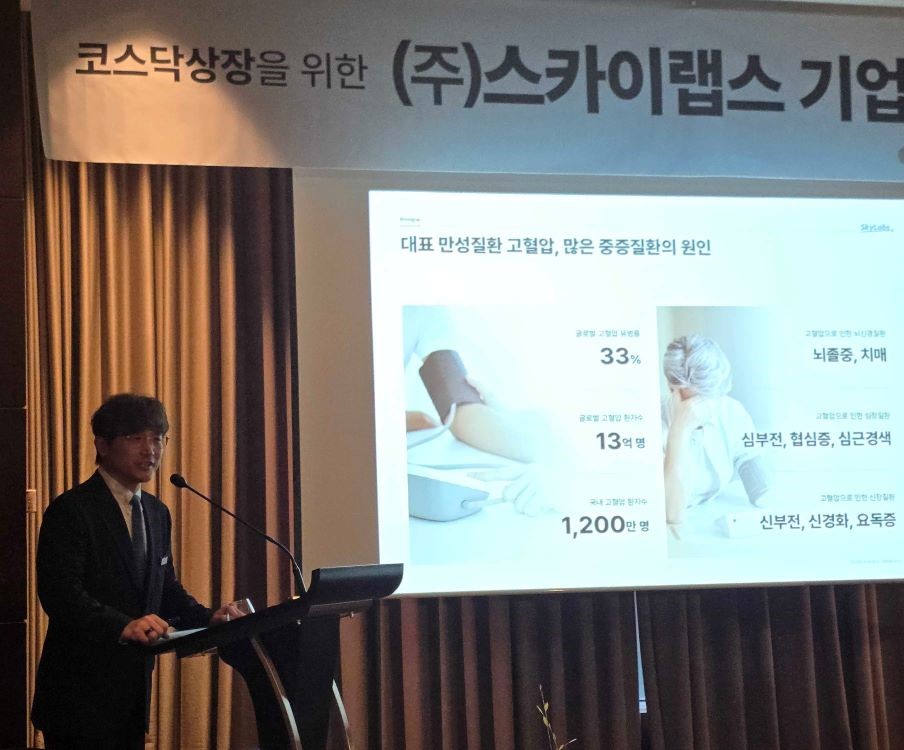
SkyLabs, a South Korean medical-data company built around a ring-type cuffless blood pressure monitor, confirmed a KOSDAQ listing for September following an August 21 investor briefing in Seoul. Its flagship device, CART BP pro, is now deployed in more than 1,800 clinics and hospitals across Korea, including all five of the country's largest hospitals and 38 of 47 tertiary general hospitals. SkyLabs reported $18.4M in first-half 2026 revenue, with $9.5M (52%) from overseas markets, supported by European CE-MDR clearance and an exclusive Japan distribution agreement signed with Otsuka Pharmaceutical in February, alongside a partnership with OMRON Healthcare. The company is also pursuing FDA clearance for a cuffless continuous blood pressure monitor, targeting approval by the end of 2027 after U.S. clinical trials.
The listing underscores a shift underway in vertical health AI: value increasingly accrues not from the diagnostic device alone but from the longitudinal biosignal data it generates. SkyLabs frames its device rollout — expanding from blood pressure to oxygen saturation (CART O2) and multi-vital monitoring (CART VITAL) — as feeding a clinical data platform, CART NET, that supplies pharmaceutical companies and CROs with real-world evidence for drug trials and remote monitoring. That platform is already used in a long-term cohort study run by the Korea National Institute of Health, giving the company a regulator-adjacent reference case ahead of its U.S. push.
For investors, the near-term signal is IPO pricing and whether the market credits SkyLabs' projected ramp — from $74.3M in 2026 to $281.8M in 2028 — which the company says excludes meaningful contribution from CART O2, CART VITAL, or CART NET. For builders in health-data infrastructure, the more durable takeaway is the sequencing: device distribution first, data-platform monetization second, with FDA clearance as the gating event for U.S. expansion rather than a starting point.