Wisora AI bot integrates with LINE official accounts for enterprise auto-response
The AMW Read
Incremental product launch (AI bot + LINE integration) within Japan's enterprise chatbot space; no new funding or structural shift, but the channel distribution pattern is notable for the regional market.

Wisora AI bot integrates with LINE official accounts for enterprise auto-response
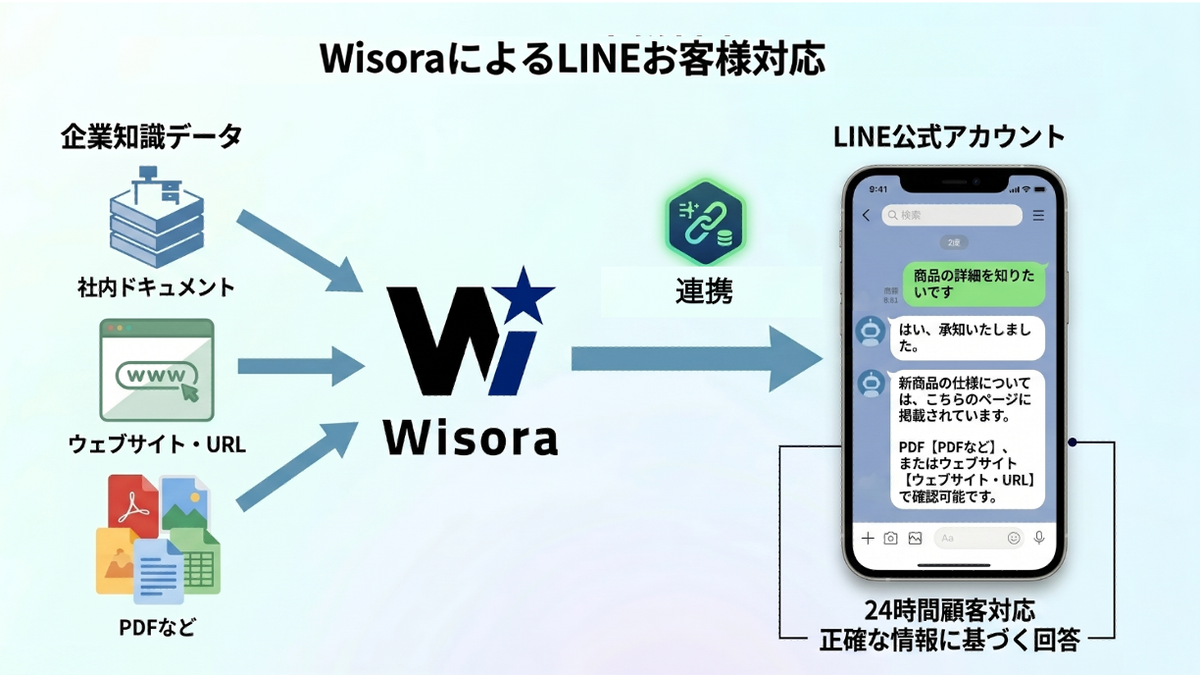
SoraCom (ソラコム) has launched an integration between its generative AI bot service Wisora (ウィソラ) and the LINE official account management tool L-Step, enabling companies to deploy AI-powered automatic responses within LINE messaging flows. Wisora allows enterprises to train AI bots on proprietary data from web pages, manuals, PDFs, and Word documents, and now extends that capability to LINE — Japan’s dominant messaging platform — alongside existing channels including web widgets, Slack, and Microsoft Teams. Pricing starts at ¥40,975/month (~$270) for the Starter plan and ¥134,750/month (~$890) for the Pro plan.
Why it matters: This integration exemplifies the hyperscaler-distribution pattern — embedding AI into existing platform ecosystems that already own massive user bases, rather than trying to build standalone consumer adoption. LINE, with over 90 million monthly active users in Japan, represents a high-density distribution channel where enterprise AI can reach end users without friction. Wisora is not a foundation-model player but an applied-AI layer that piggybacks on LINE’s social graph, similar to how Cursor piggybacks on VS Code or how Copilot piggybacks on GitHub. The playbook is tactical: offer a plug-in that upgrades an existing workflow rather than forcing users to adopt a new interface.
The ground-level take: Wisora’s move updates the customer-facing AI chatbot segment in Japan, a market where LINE has historically been the primary business-customer communication channel. The pricing structure — ¥41K Starter and ¥135K Pro — positions it as a mid-market SMB-to-enterprise tool, not a hyperscaler play. The key differentiator is the ability to train on internal documents (including Google Drive files) and surface response provenance, which addresses the enterprise trust gap around hallucinated or untraceable AI answers. For SoraCom, which traditionally operates in IoT connectivity, this is a pivot toward AI-augmented customer engagement — a lower-margin, higher-volume adjacency. The novelty is moderate (AI chatbot + LINE integration is not unprecedented), but the significance in Japan’s LINE-centric business ecosystem is meaningful, especially for companies that lack in-house AI engineering teams.