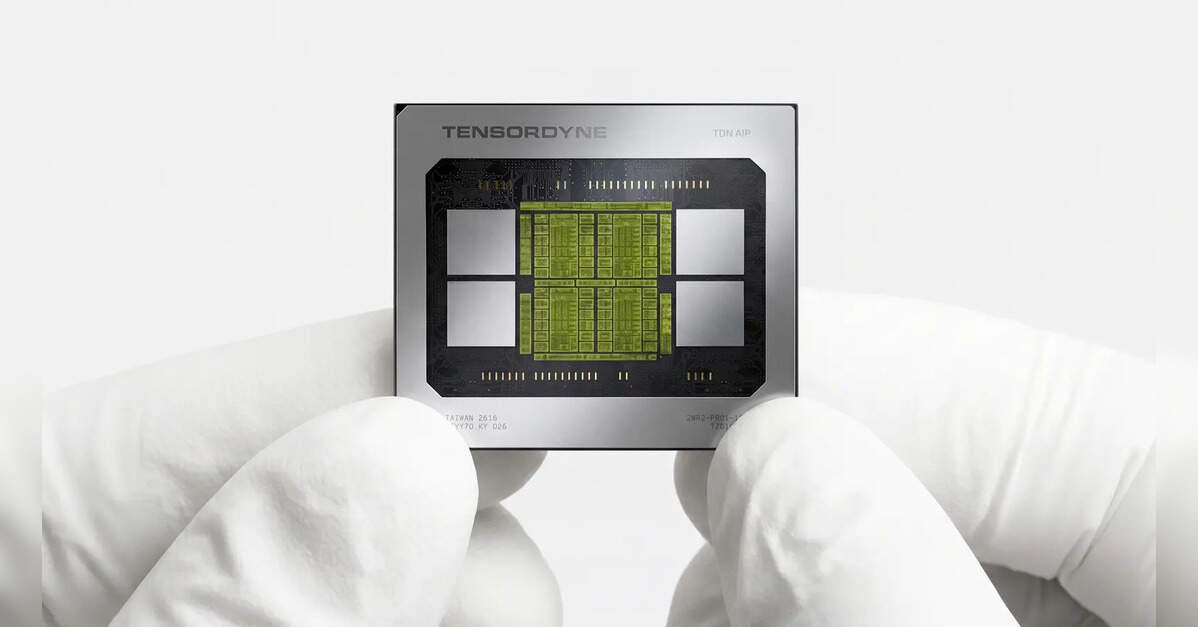
Tensordyne forecasts $200M in AI inference system orders ahead of Napier chip launch
The AMW Read
Incremental update on a known player (Tensordyne rebranded from Recogni); the $200M forecast and Napier chip launch are meaningful for the AI infrastructure segment, with cross-substrate implications for silicon competition.

Tensordyne forecasts $200M in AI inference system orders ahead of Napier chip launch
Tensordyne, an AI chip startup formerly known as Recogni, has announced it expects over $200 million in orders for its upcoming inference system built around the new Napier chip. The company has secured more than a dozen evaluation commitments, with Cirrascale and BlueSky Compute among interested infrastructure providers. The Napier chip was developed in collaboration with Broadcom and Juniper Networks, and will be manufactured by TSMC.
Why it matters: This announcement highlights the intensifying race to build alternatives to Nvidia in the AI inference market, which is rapidly becoming the largest segment of AI compute demand as generative AI applications scale. Tensordyne's claimed $200M in forecast demand signals enterprise appetite for power-efficient, high-density inference hardware. The company is positioning its architecture as a solution to key pain points — rising power consumption, inference latency, and data center capacity constraints — that are driving hyperscalers and cloud providers to evaluate non-Nvidia options.
Grounded expert take: Tensordyne's trajectory exemplifies the acqui-licensing and partner-driven go-to-market pattern common in the AI silicon substrate: building on TSMC manufacturing, Broadcom networking, and HPE/Juniper distribution to bypass the need for vertical integration. With $176M in prior funding and a Series D on the horizon, the company is entering a capital-intensive race where success depends on actual deployment benchmarks rather than paper specs. The inference segment is becoming the primary battleground for challengers to Nvidia's dominant position.
