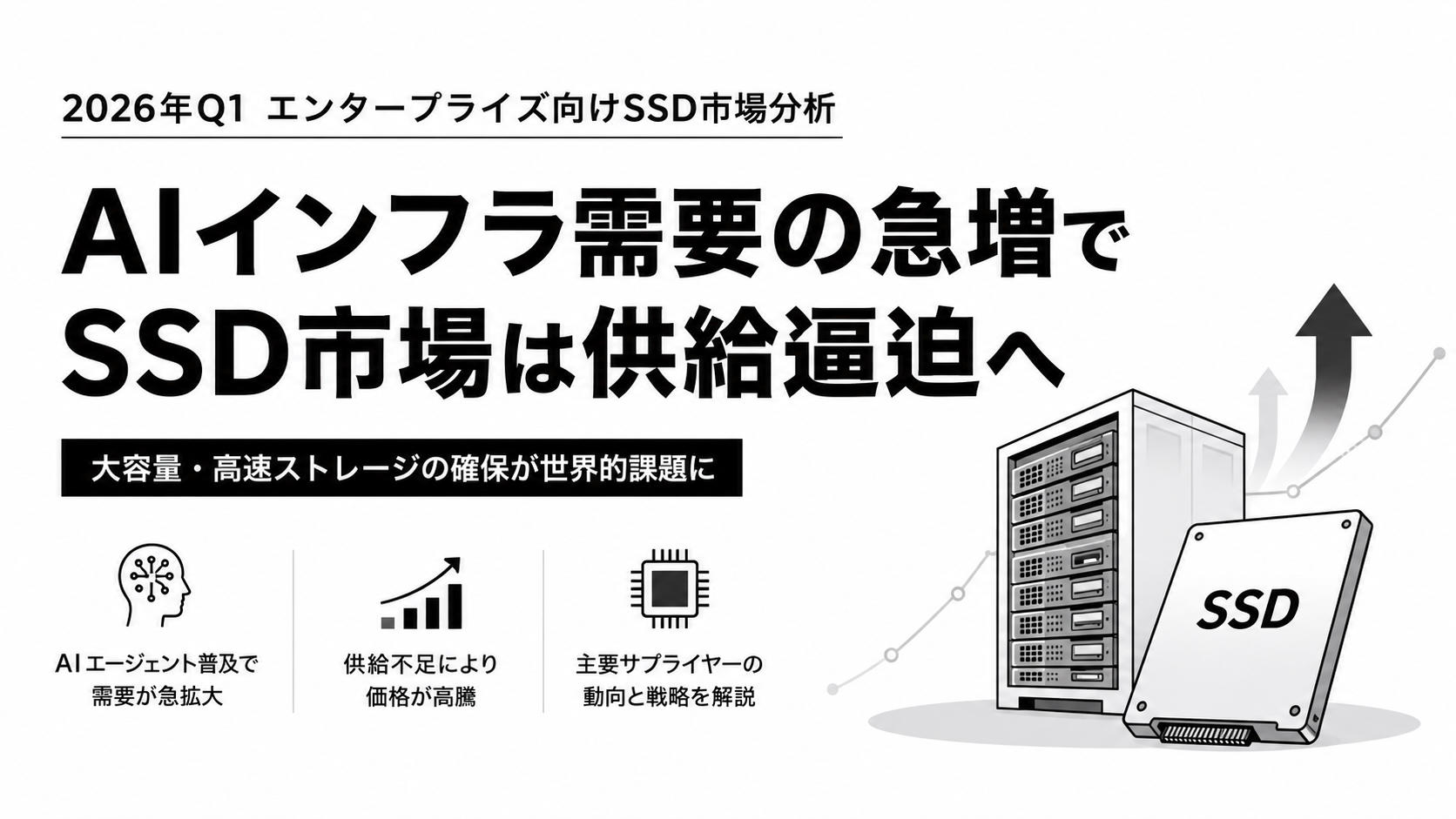
TrendForce: AI Agent Growth Drives Enterprise SSD Supply Crunch, Prices Spike 80%.
The AMW Read
The article provides an incremental update on enterprise SSD market dynamics driven by AI agents, confirming known supply trends but adding significant revenue and price data; the storage bottleneck shift has segment-level implications for AI infrastructure.
TrendForce: AI Agent Growth Drives Enterprise SSD Supply Crunch, Prices Spike 80%.
Research firm TrendForce reported on June 11, 2026 that Q1 2026 enterprise SSD revenue hit a record $18.46 billion, up 86.1% QoQ, driven by surging cloud provider demand from AI agent deployments. The top five suppliers nearly doubled their sales, but inventory fell to historic lows while orders far outpaced manufacturing capacity. Contract prices rose roughly 80% as vendors leveraged a seller's market. Samsung led with $7.05B (92.8% QoQ growth), SK Hynix/Solidigm and Micron each posted strong gains, while Kioxia and Sandisk/Western Digital also benefited.
Why it matters: This signals a structural shift in AI infrastructure economics. SSDs are transitioning from passive storage to active compute components in memory hierarchies, particularly as DRAM capacity limits and cost constraints push high-performance NAND into caching and context-storage roles for AI agents. The supply crunch exemplifies the hyperscaler distribution moat pattern: only cloud providers with deep supplier relationships can secure enough high-capacity SSDs to keep pace with agent workload growth. The price spike also ripples downstream, pressuring enterprise AI capex budgets and reinforcing the capital-compression arc for startups relying on inference infrastructure.
Grounded expert take: TrendForce's data confirms that the compute bottleneck is migrating from GPU availability to storage density — a theme underrepresented in current market narratives. Micron's 120% revenue surge and Samsung's 236-layer shift show that NAND layer-count races now mirror GPU process-node races. The move toward QLC and 240+ layer products will ease supply by late 2026, but near-term, enterprises face a hard trade-off: pay 80% more for SSDs, or delay system builds. This tightens the virtuous cycle for hyperscalers who can self-maintain inventory buffers, while smaller players risk being priced out of agent-serving infrastructure.
#EnterpriseSSD #AIInfrastructure #AgentWorkloads #NANDFlash #HyperscalerMoats #MarketSupply