Unitree launches GD01 rideable humanoid mecha robot from $650,000
The AMW Read
Novelty 2: Unitree extends beyond humanoid into manned mecha, a new product category not previously in its canon. Significance 2: The product could reshape the civilian robotics segment if mass-produced, but unresolved specs and IPO timing leave impact uncertain.

Unitree launches GD01 rideable humanoid mecha robot from $650,000
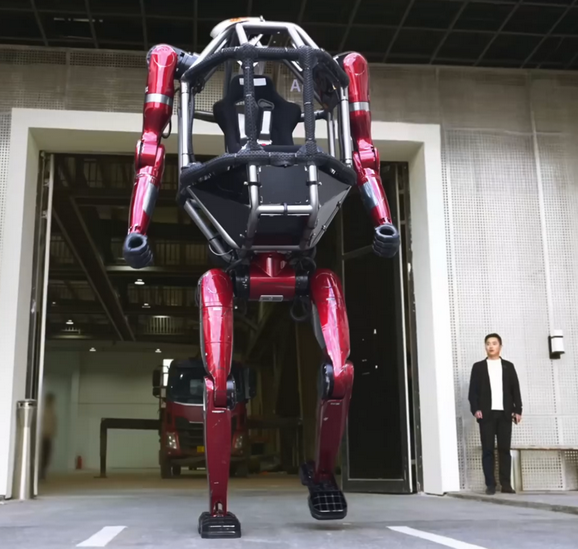
Chinese robotics company Unitree (유니트리) has unveiled the GD01, a rideable bipedal/tetrapod mecha robot priced from RMB 3.9 million (~$650,000). The 2.8m-tall, ~500kg machine features a racing seat and roll cage inside its upper body, and can transition to quadrupedal crawling for stability on rough terrain. Founder Wang Xingxing (王囍囍) appears in promotional footage riding the robot. Unitree frames the GD01 as the world's first mass-producible manned mecha and a civilian transport platform.
Why it matters: The GD01 pushes Unitree beyond the humanoid robot race that defined its global reputation (the G1 performing backflips and tennis) into a speculative new category—rideable physical AI. This move echoes the "hardware-as-spectacle" pattern seen in early Boston Dynamics demos and Chinese quadcopter drone companies. However, critical specs (speed, battery life, controls) remain undisclosed, and observers note some finish details (bicycle-tire frame trim, dummy-only riding in live demos) that seem inconsistent with a production-ready claim. The product lands at a moment when Unitree is reportedly preparing for a Shanghai STAR Market IPO, adding capital-cycle pressure to deliver a narrative-shifting product.
Grounded expert take: Unitree is testing whether physical AI can command a luxury-vehicle price point before any practical use case is proven. Entertainment, extreme-terrain exploration, and structural inspection are plausible niches, but the $650K starting price means it will compete less with other robots and more with heavy machinery, concept cars, and high-end toys. The lack of published battery life or operational speed makes it impossible to evaluate real utility. This is less a product launch than a proof-of-concept marketing event calibrated to attract IPO investor attention. The underlying robotics stack—derived from the Go series of quadruped algorithms—is real, but putting a human on top introduces safety and liability questions that Unitree has not yet addressed.