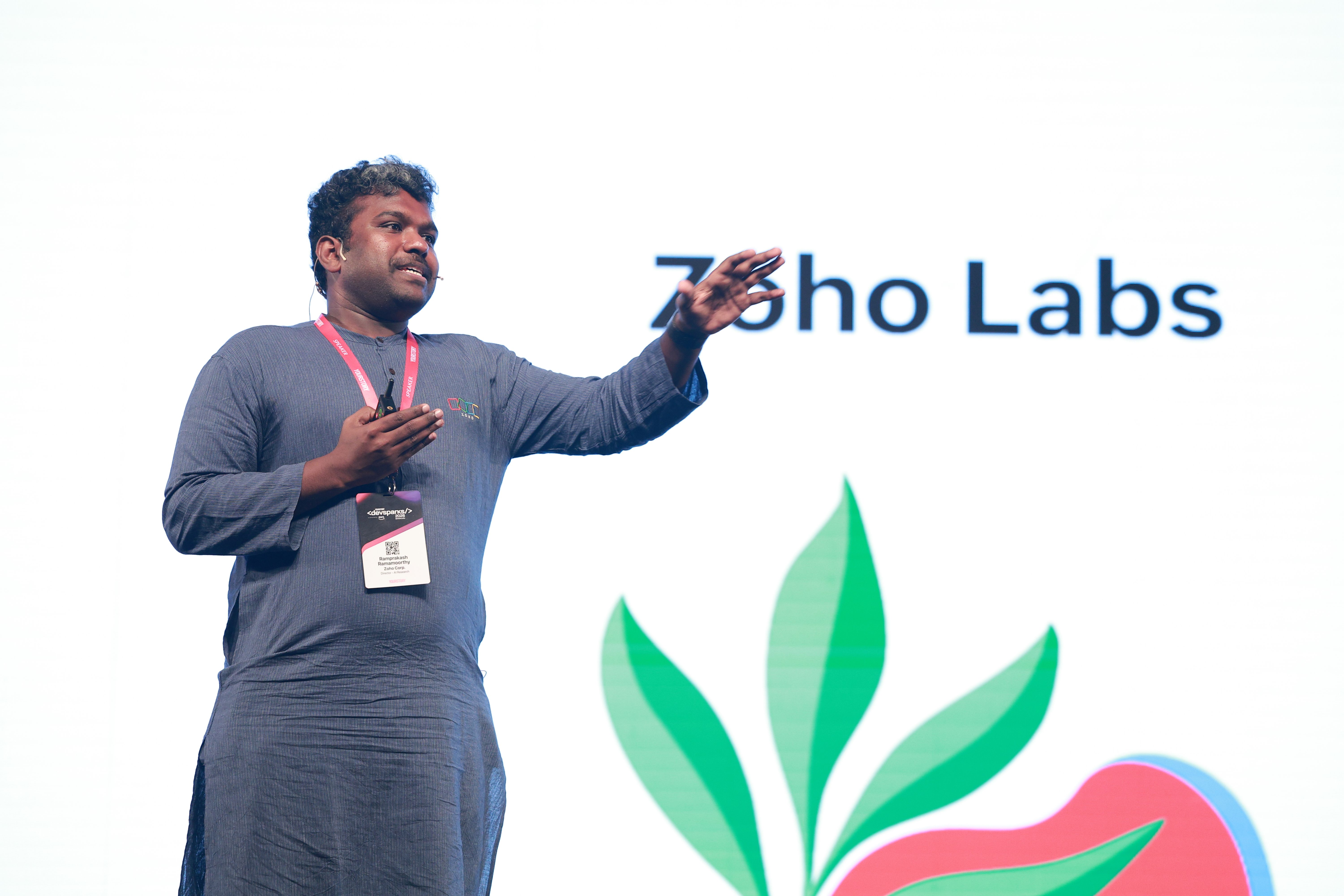
Zoho Labs pivots to inference engineering for open-weight models at DevSparks 2026
The AMW Read
Incremental update to Zoho's known trajectory; significance is sub-segment for inference efficiency among enterprise adopters.

Zoho Labs pivots to inference engineering for open-weight models at DevSparks 2026
At DevSparks 2026 in Bengaluru, Ramprakash Ramamoorthy, Director of AI Research at Zoho Corp., detailed how Zoho Labs has shifted its primary focus from building proprietary models to inference engineering for open-weight models. The lab, established to solve recurring engineering problems across Zoho's 100-plus product portfolio, spent five years developing a 15-language-pair translation system that was rendered obsolete in 2023 by open-weight models supporting 90 language pairs for free. The team now concentrates on squeezing maximum efficiency from existing transformer models, employing techniques such as quantization, KV cache management, continuous batching, and speculative decoding across roughly six billion monthly API calls on a constrained GPU budget.
Why it matters: Zoho Labs embodies a structural shift playing out across in-house AI teams globally—the 'capital-compression arc' in which the rapid commoditization of foundation-model training forces labs to reinvent their purpose. Rather than chasing the frontier, Zoho has anchored its strategy in the inference-efficiency moat, a pattern increasingly visible among mid-tier enterprise players who cannot outspend hyperscalers on pre-training. The 101% project strategy—extracting incremental gains from production models rather than building new ones—reflects a broader recalibration where technical differentiation shifts from model architecture to systems engineering at inference time.
The expert take: Ramamoorthy's framing—'the train has passed for training general-purpose models'—captures a pragmatic response to the open-weight deluge. For bootstrapped enterprises with large product surfaces but finite GPU budgets, inference engineering becomes the only scalable differentiator. Zoho's multi-pronged approach—the AI Bridge connect layer, a small in-house utility model, and heavy inference optimization—represents a replicable pattern for the 'fast follower' class of AI adopters. The speculative decoding analogy (engineers use Sonnet to draft, Opus to debug) underlines a meta-lesson: even the optimization techniques themselves benefit from a tiered, cost-aware architecture.
#ZohoLabs #InferenceEngineering #OpenWeightModels #EnterpriseAI #Transervers #IndiaAI