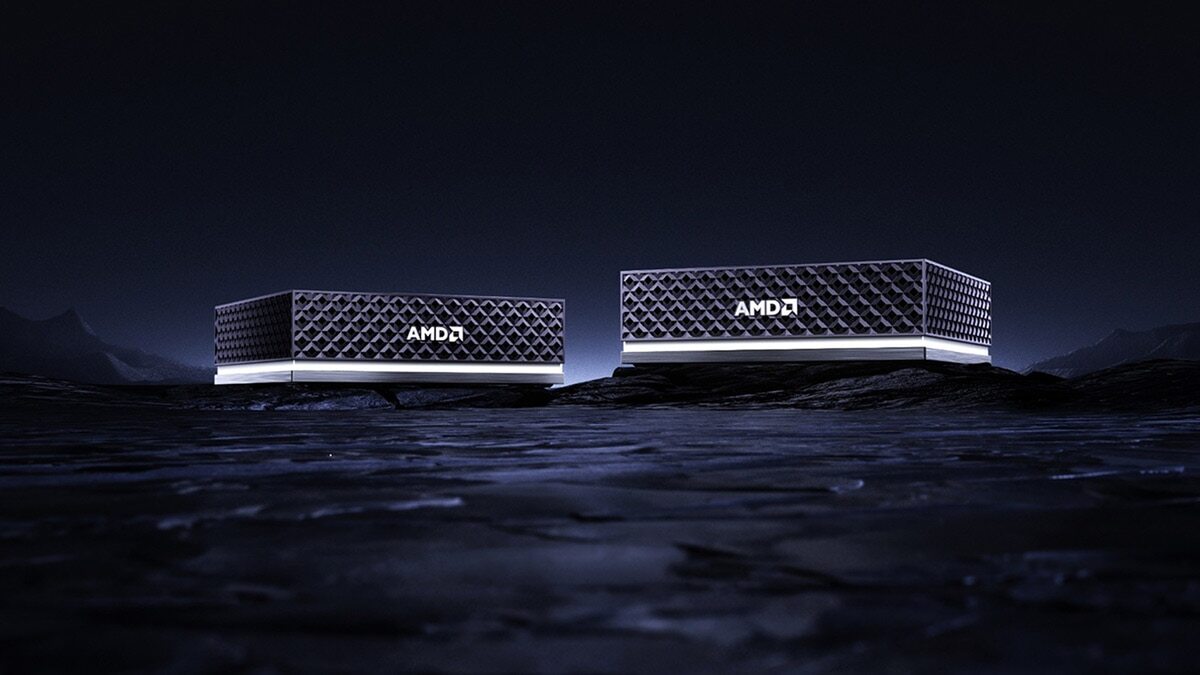
AMD has unveiled the Ryzen AI Halo platform, a compact local AI development system powered by the Ry...
The AMW Read
AMD's dedicated local AI workstation is a meaningfully new product category from an established silicon player, but the platform remains unproven against NVIDIA's entrenched ecosystem; segment-level impact likely.
AMD has unveiled the Ryzen AI Halo platform, a compact local AI development system powered by the Ryzen AI Max+ 395 processor, priced at $3,999. The system features 128 GB of unified memory and is designed to run models up to 200 billion parameters locally, including large Mixture-of-Experts (MoE) architectures such as Qwen3-235B-A22B and DeepSeek-V2. It supports both Windows and Linux, with ROCm optimizations for generative AI workloads. AMD also announced the Ryzen AI Max PRO 400 series for enterprise PCs and mobile workstations, with up to 192 GB unified memory and claimed support for models up to 300 billion parameters. OEM systems from HP and Lenovo are expected in Q3 2026.
Why it matters: This announcement signals a direct challenge to NVIDIA's DGX Spark in the emerging market for high-end, local AI developer workstations. By targeting the same developer persona — one who needs to download, run, and fine-tune frontier-class open-weight models on premises — AMD is attempting to break NVIDIA's grip on the local AI prototyping segment. The $3,999 price point, positioned against the $4,699 DGX Spark, suggests AMD is using its x86 client processor heritage and unified memory architecture as a wedge to undercut NVIDIA's pricing while offering comparable local model capacity. This play directly ties into the hyperscaler-distribution moat pattern: AMD lacks NVIDIA's CUDA ecosystem lock-in but is betting that ROCm maturity and the sheer convenience of unified memory for MoE models will win over developers who prioritize flexibility over peak throughput.
Expert take: AMD is not just launching a product; it is testing whether an alternative hardware substrate can sustain a competing local AI development workflow. The strategic bet rests on two assumptions: first, that the open-weight model community will increasingly favor large MoE architectures (200B-300B total parameters) that benefit from large unified memory pools, and second, that ROCm's software stack has reached sufficient parity with CUDA for this specific use case. If AMD succeeds, it could fragment the AI developer hardware market into two tiers — NVIDIA for training at hyperscale, AMD for local prototyping and inference. But the company must still overcome the installed base of CUDA-optimized tooling and developer habits. The Q3 2026 OEM rollout will be the real test of ecosystem readiness.