Ascent AI launches 'ListeningMind.AI' marketing agent platform with deterministic intent data engine
The AMW Read
Incremental product launch from a previously unindexed Korean player; adds one more data-moat agent to a crowded sub-segment but does not change the competitive landscape.
Ascent AI launches 'ListeningMind.AI' marketing agent platform with deterministic intent data engine
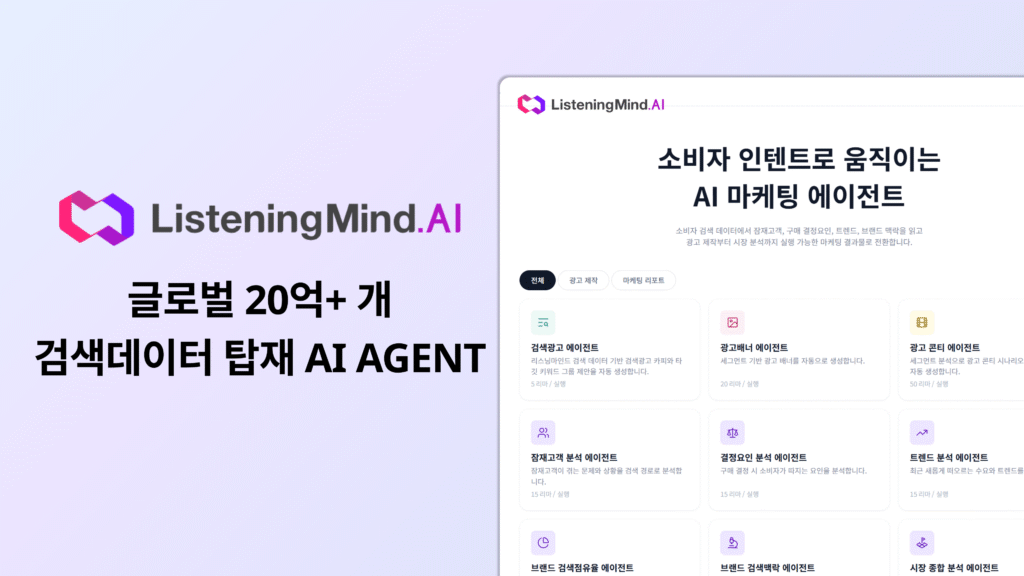
South Korean data-tech firm Ascent AI (어센트 AI) has formally launched ListeningMind.AI, an AI agent platform purpose-built for marketing automation. The platform integrates with the company's proprietary search-intent analysis engine, ListeningMind, which is powered by a 3PB (3,000 TB) dataset of Korean, US, and Japanese consumer search-intent data. Unlike typical LLM-based agents, ListeningMind uses deterministic algorithms rather than probabilistic inference. The platform offers two core agents: an Ad Creative Production Agent that generates ad banners and 10-shot video storyboards (PPM-level), and a Marketing Report Agent that produces persona analyses, key buying factors, and customer decision journey reports using a multiple-choice UI instead of open-ended prompts.
Why it matters: ListeningMind.AI exemplifies a distinct pattern in the AI agent substrate — the context-engineering moat built on proprietary, structured data rather than general-purpose model reasoning. Ascent AI is positioning its deterministic intent engine as a defensible alternative to LLM-based marketing tools that rely on scraped or shallow survey data. This mirrors the broader structural shift in Segment 02 (AI Agents) where application-layer companies are increasingly differentiating through data-side moats rather than model-side capability. The focus on objectivity (click-based UI, deterministic algorithms) also attempts to address the 'answer machine' skepticism that has emerged around generative AI in enterprise marketing workflows, a tension captured in the open debate around agent reliability in professional settings.
Ascent AI CEO Park Se-yong framed the platform not as a productivity short cut but as a 'partner' for marketer reasoning, signaling a deliberate rejection of the AI-as-oracle paradigm. While still an early-stage product from a relatively small Korean entrant, the company's emphasis on deterministic, proprietary intent data over LLM inference positions it within a recurring pattern we track: data-moat agents that aim to outcompete on factual grounding rather than generative breadth. The company plans to expand into 'Team Agent' configurations that combine domain-expert personas from copywriters and strategists — a move that could test whether agent specialization plus data exclusivity is a viable path against marketing platforms backed by hyperscaler distribution.