Asteromov Records Gold-Medal-Level Score in International Physics Olympiad Theory Exam
The AMW Read
A new Korean scientific-reasoning model system adds a capability datapoint to the foundation-model player map, but a single Olympiad result has limited demonstrated market impact.

Asteromov Records Gold-Medal-Level Score in International Physics Olympiad Theory Exam
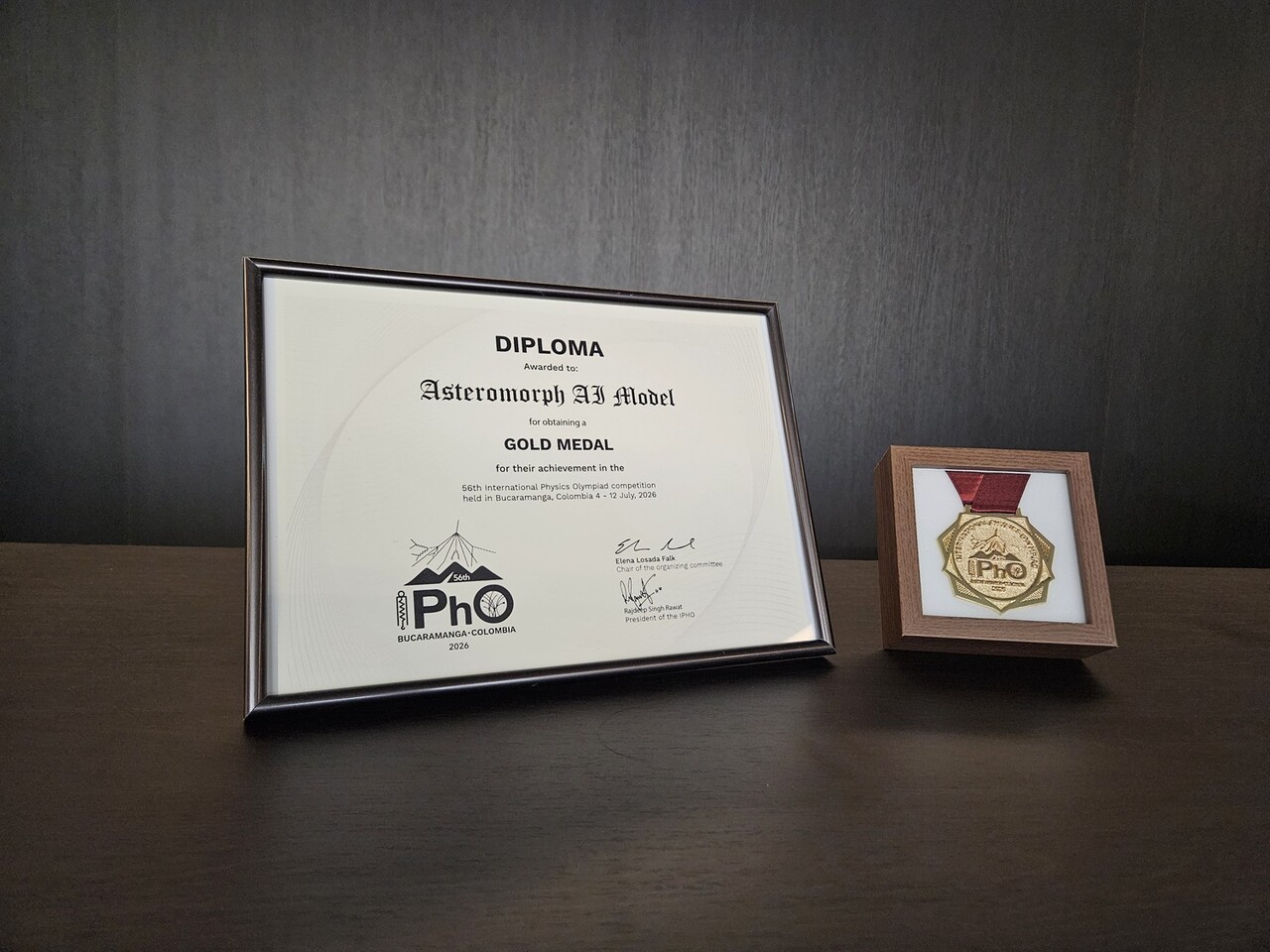
Asteromov, a Korean AI startup founded in February 2025, said its system scored 28.6 out of 30 on the theoretical examination at the 56th International Physics Olympiad, held in Bucaramanga, Colombia, in July. The company said the result met the gold-medal threshold and that organizers awarded an official diploma and medal. Its engineering team sat the five-hour exam alongside human contestants under the same exam and scoring criteria.
Rather than relying on one model, Asteromov built a system combining open-source LLMs with its own models and components, running on AWS cloud infrastructure. It processed the original exam paper, including text, equations, drawings, graphs, and physical diagrams, then carried out problem interpretation, multi-step reasoning, verification, and final-answer generation without external model APIs or online search. Meta Superintelligence Labs and Huawei also participated in the on-site AI evaluation, according to Asteromov.
For the AI market, the result is a narrowly defined but relevant signal for scientific-reasoning systems: performance depends not only on a base model's answer quality but also on the surrounding architecture that can parse mixed-format inputs, sustain physical reasoning, and check its work under a fixed time budget. Builders targeting research workflows should treat olympiad results as evidence of system integration rather than proof of production usefulness; investors should look next for repeatable results on real scientific tasks, where reliability, auditability, and workflow fit determine commercial value.