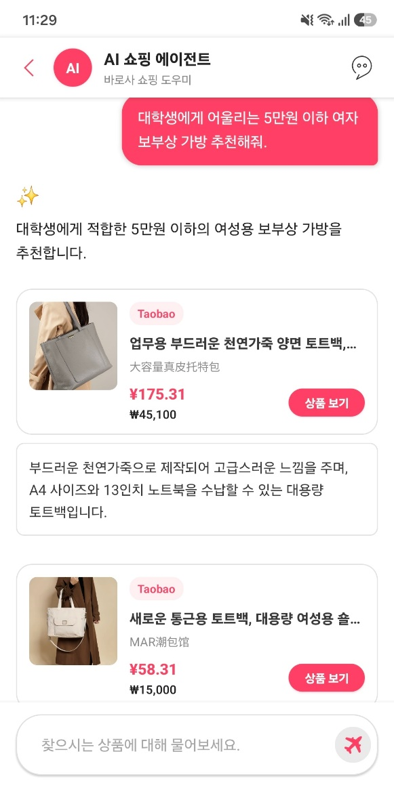
Barosa launches AI shopping agent for Taobao with Korean colloquial search.
The AMW Read
Novelty 1: Barosa is a new entrant, but the pattern of LLM-based shopping agents is established. Significance 2: Impacts cross-border e-commerce flows and demonstrates context-engineering moat in a specific vertical.

Barosa launches AI shopping agent for Taobao with Korean colloquial search.
South Korean cross-border shopping app Barosa has launched an AI shopping agent for Taobao that interprets Korean colloquial phrases like "보부상 가방" (peddler bag) by querying Taobao with LLM-generated optimized Chinese search terms. In beta, the agent achieved a 25% higher search success rate, 40% faster search time, doubled click-through rate, and 22% improvement in purchase conversion. Barosa plans to expand the AI agent to other Chinese platforms like 1688 and Weidian later this year.
This launch exemplifies the "context-engineering moat" pattern (Segment 02, corpus_refs 02.§5.4), where LLM-based agents outperform simple translation by understanding user intent and product attributes. It also updates the AI commerce agent landscape, showing how cross-border e-commerce pain points create immediate product-market fit for conversational AI. The agent reduces language barriers that have historically limited Taobao direct purchase volumes, potentially accelerating cross-border e-commerce growth from Korea.
Barosa's focus on Korean colloquial search mechanics — handling slang, tone, and contextual cues — demonstrates that verticalized AI agents can carve defensible niches against general-purpose assistants. The 22% conversion lift suggests that intent-aware product discovery is a tangible revenue driver, not just a convenience feature. This positions Barosa as a case study in localized AI agents for cross-border retail.