Coupang and CJ Logistics Push Robotic Hands Into Warehouse Operations
The AMW Read
Two large Korean logistics operators are advancing warehouse manipulation from PoCs toward limited deployment, but the source still reports unproven ROI and site-specific adaptation.

Coupang and CJ Logistics Push Robotic Hands Into Warehouse Operations
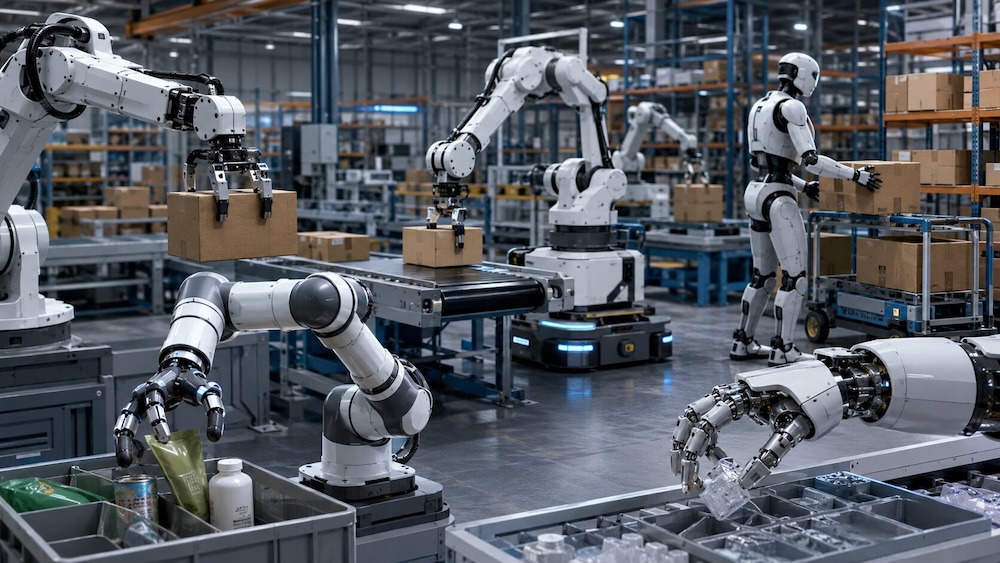
Coupang is testing robotic handling with Cmes Robotics and other suppliers at its Yangji fulfillment center in Yongin, where it is pursuing 100% automation. CJ Logistics has moved beyond testing by placing two dual-arm humanoid robots on the packing line at the Olive Young logistics center in Yangji, Yongin; they insert cushioning material into boxes. It is also working with AIDIN Robotics on dexterous hands and with physical-AI startup RealWorld on a robot foundation model for logistics use.
The shared target is warehouse work that conventional automation has left to people: picking, transferring, and packing items with changing sizes, surfaces, locations, and packaging. Vision-language-action models and robot foundation models may widen the tasks a robot can handle without redesigning every motion, but the companies and suppliers still describe deployment as early. Accuracy, human intervention after failures, facility-specific retraining, and return on investment remain unresolved; robots can still be slower than people even if they can operate continuously.
For builders, the near-term product is not a general-purpose humanoid but a system that can reliably complete a narrow warehouse job, recover from exceptions, and adapt quickly when moved between sites. For investors, the key proof point is repeatable throughput and retraining economics across facilities, rather than a single pilot or a humanoid demonstration. CJ Logistics' live packing deployment provides an early operating reference for South Korean logistics operators, while Coupang's tests indicate where demand for practical robotic dexterity may emerge.