Dream Labs raises $90 million and launches Dream API for robot control
The AMW Read
The funding and API launch repeat the supplied prior coverage, but transferable robot control could affect deployment economics across hardware makers.

Dream Labs raises $90 million and launches Dream API for robot control
Dream Labs announced $90 million in seed funding led by B Capital, alongside Kindred Ventures and other investors. It also launched Dream API, which translates camera inputs and plain-English instructions into robot actions. Its Dream-1 model learns from video of people performing tasks. The company says it can control unfamiliar robots with grippers without additional training data. Current tasks include tabletop object handling and folding laundry. Dream Labs works with more than 20 hardware partners, supporting robots priced at about $2,000 to $10,000.
The market question is whether a shared robot model can reduce the programming work required for each machine and task. Dream Labs places the intelligence layer above individual hardware makers, offering developers a common interface across different robots. That could shift competition toward transferable control models and deployment support as robot hardware becomes more affordable. However, the article provides no measured task-success rates or independent comparisons. Dream Labs also refines models for its hardware partners, so its general control capability and hardware-specific performance remain separate questions.
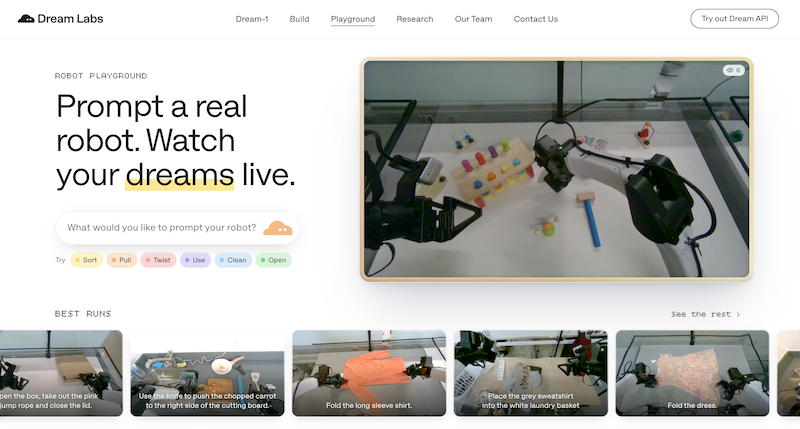
Builders can test that distinction through Dream API and Robot Playground, which accepts browser commands for robots in the company's San Francisco office. For unsupported hardware or new capabilities, Dream Labs offers fine-tuning from demonstration data, with tailored models promised within hours. Investors should assess whether those adaptations reduce deployment effort while keeping task performance reliable. The company says funding will primarily support compute as it expands model capabilities and serves more users; the practical test is repeatable useful work across supported machines.