Spirit AI, a Chinese embodied intelligence startup, has completed a 1.5 billion yuan (approximately...
The AMW Read
Novelty=2 because Spirit AI is a new top-tier entrant in robotics foundation models, updating the player map with a record funding and a benchmark win over Nvidia. Significance=2 because the event reshapes the competitive landscape in embodied AI at the segment level, but does not yet resolve the op
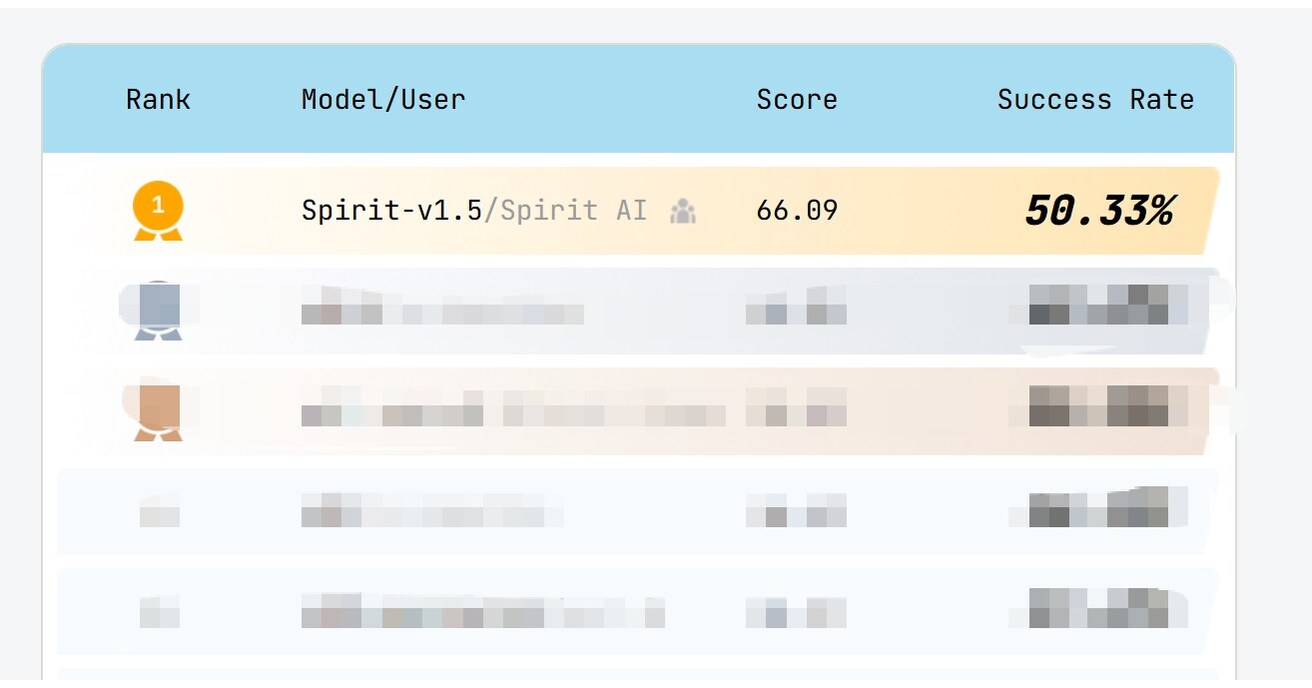
Spirit AI, a Chinese embodied intelligence startup, has completed a 1.5 billion yuan (approximately $206 million) A+ funding round, the largest single round in China's embodied intelligence sector to date. The round was co-led by top-tier US dollar funds, major industrial capital, and national state-owned funds, with existing shareholders significantly increasing their participation. On the same day, Spirit AI announced that its self-developed Spirit v1.6 foundation model reached the top of the North American RoboArena leaderboard, outperforming Nvidia Cosmos3 and becoming the first Chinese embodied model to achieve a global number-one ranking.
Why it matters: This dual event — a record funding round paired with a benchmark victory over a Silicon Valley rival in a North American arena — exemplifies the 'fastest-ARR-ramp' pattern in embodied AI and signals that Chinese robotics foundation models are now competing head-to-head with US leaders on technical merit. The capital structure, spanning US dollar funds, sovereign wealth, industrial giants, and state-owned assets, reflects a mature cross-border funding model that has become common in China's frontier AI verticals. Spirit AI's stated focus on automotive manufacturing and smart logistics targets the same commercial beachheads as Dyson and Figure, but with a China-centric manufacturing base that could accelerate deployment.
Grounded expert take: Spirit AI emerges as a top-tier contender in the robotics foundation model segment, updating the player map previously dominated by Nvidia's Cosmos and US-based startups like Figure. The A+ round's size and diverse cap table indicate strong institutional conviction that physical general intelligence will commercialize first in industrial settings, not consumer robotics. The RoboArena result is particularly noteworthy because it benchmarks against Nvidia's deeply resourced Cosmos3 — a direct product test, not just a paper comparison. The key open question remains whether Spirit AI can translate benchmark performance into real-world production-line reliability and unit economics that beat existing industrial automation, which is a higher bar than simulation rankings. The China focus on automotive and logistics mirrors the pattern seen in autonomous driving, where regulatory support and manufacturing density gave local players an edge.