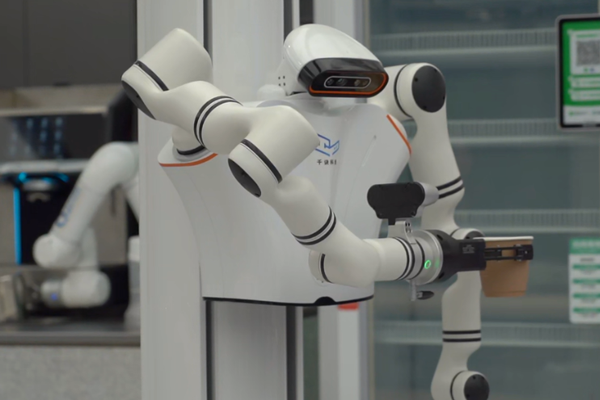
Qianjue Technology (千诀科技), an embodied intelligence company spun out from Tsinghua University’s Brai...
The AMW Read
Introduces a new entrant with a distinctive predictive-world-model architecture in Seg 10 robotics, updating the player map and canonically challenging the generative paradigm, but the round is below cross.§D threshold and the company is still pre-baseline for cross-segment impact.

Qianjue Technology (千诀科技), an embodied intelligence company spun out from Tsinghua University’s Brain-inspired Computing Center, has closed a Series A round of several hundred million yuan (approximately $40M–$70M). The round was led by Jingming Capital (京铭资本) with participation from Shandong New Kinetic Energy, Shandong Caijin Capital, Yuanhe Hopes, Xineng Venture Capital, Nanchuangtou, InnoAngel Fund, Shangshi Capital, Renai Group, and Xuansu Investment. The company builds predictive world models for robotics, using a distributed architecture inspired by how brain regions cooperate, and claims to have deployed its technology in over 100,000 edge devices across hotel cleaning, commercial service, indoor precision work, and drone scenarios.
Why it matters: Qianjue’s approach is a direct challenge to the generative paradigm (pixel-level video prediction) favored by many world-model labs. By instead predicting low-dimensional physical-state trajectories—and by decoupling the “brain” (perception/planning) from the “body” (actuation)—the company aims to reduce the sample complexity of robot learning. If validated at scale, this could reshape the moat structure in embodied AI: rather than depending on massive compute for pixel-prediction pretraining, the advantage would shift to building high-quality, state-space representations that transfer across robot form factors. The pattern echoes earlier debates in foundation-model vision about latent-space compression vs. pixel-level reconstruction, now playing out in the physical world.
Expert take: Qianjue’s distributed predictive architecture is a meaningful differentiator in the world-model space that remains theoretically open. It updates the canonical player map in embodied intelligence (Segment 10), where most Chinese contenders—Unitree, Zhiyuan (智元), and Stardust—compete on hardware and data scale rather than architectural choice. Qianjue is effectively betting that the “feature pollution” problem (mixing task-irrelevant pixel noise with causal structure) is a fundamental limit of generative world models, and that predictive abstraction will yield faster, cheaper, and more generalizable robot control. The capital compression arc may now favor architectural bets over scale-first approaches if Qianjue’s ten-thousand-unit deployments show materially lower retraining overhead when switching to a new robot platform.