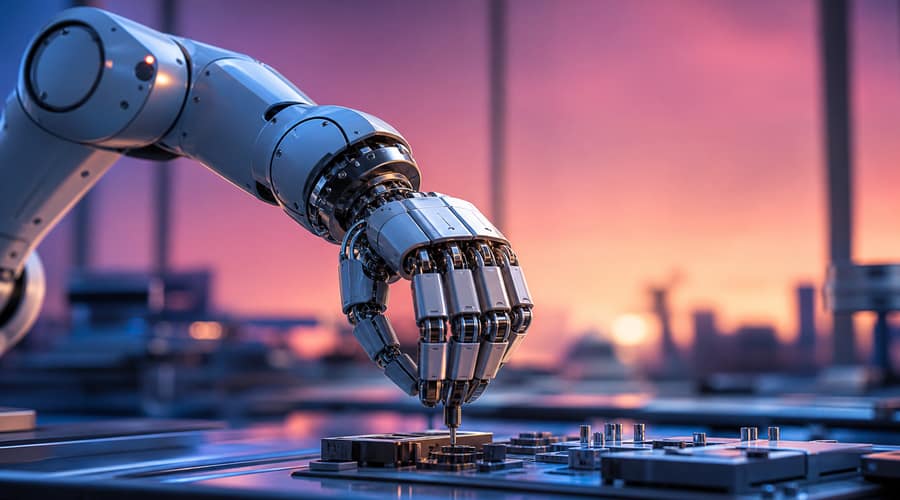
Genesis AI releases first robot foundation model GENE-26.5, demonstrating single-model dexterous manipulation.
The AMW Read
Introduces a new full-stack player that compresses the typical robotics foundation model timeline, updating the player map (10.§2) and adding a canonical case study (10.§4); high significance because the 1:1 hand design and data-glove approach could reshape data scaling assumptions in dexterous mani

Genesis AI releases first robot foundation model GENE-26.5, demonstrating single-model dexterous manipulation.
What happened: Genesis AI, the French startup spun out of CMU and founded by the creator of the Genesis physics engine, released GENE-26.5, a unified robot foundation model that can perform 20+ complex manipulation tasks including one-handed egg cracking, dual-arm tomato chopping, Rubik's cube solving, and piano playing — all from a single set of weights. The company built every layer in-house: a custom 20-DOF, backdrivable dexterous hand (sized 1:1 to human hands), a real-time control stack (3ms latency, 500Hz EtherCAT), a multi-modal data collection glove, and a data engine feeding 200,000+ hours of heterogeneous data. GENE-26.5 requires under one hour of task-specific robot data (≈200 episodes) for most skills, with cooking task success rates at 90-95% for most sub-tasks and 50-60% for the hardest (one-handed egg cracking, knife-transfer of sliced tomatoes). The company raised a $105 million seed round in mid-2025 led by Eclipse and Khosla Ventures, with participation from Eric Schmidt and Xavier Niel.
Why it matters: Genesis AI exemplifies the fastest-ARR-ramp pattern for full-stack robotics startups, but on an accelerated timeline. Rather than licensing a model or using off-the-shelf hardware, they replicated the entire vertical stack — hardware, control, simulation, data, and foundation model — in under one year post-seed. This mirrors the playbook of Physical Intelligence but at seed-stage scale, compressing what typically takes Series B/C companies three to five years into 12 months. The explicit design choice to make the hand 1:1 human-sized collapses the 'embodiment gap' problem that has historically prevented large-scale transfer of human demonstration data to robots. By sourcing data from workers wearing the glove during normal tasks, Genesis is attempting to solve the data bottleneck without costly teleoperation — a bet that directly engages the labor-disclosure debate. The GENE-26.5 release updates the Robotics/Physical AI player map (Segment 10, §2), adds a new canonical case study that validates the 'unified trajectory joint distribution' approach (Segment 10, §4), and signals that the capital-compression arc in robotics foundation models is accelerating: a $105M seed now buys a production-grade stack that would have required $500M+ two years ago.
Expert take: Genesis AI's approach treats manipulation not as a model training problem but as a systems integration challenge, and their decision to build every layer — including a custom hand and real-time control stack — reflects a structural thesis that off-the-shelf components introduce irreducible latency and compliance gaps that undermine human-data transfer. The critical open question is whether the 200,000-hour multi-modal dataset, collected primarily with the data glove and first-person video, will scale to general-purpose dexterous manipulation at commercial reliability levels. The company's claim that simulation evaluation (using their own Genesis World engine) is 'already faithful enough' to replace real-world testing for scaling-law analysis is a strong methodological bet — if validated, it would significantly compress the compute-to-deployment cycle for robotics foundation models. However, the sub-60% success rate on the hardest cooking sub-tasks, combined with operator speeds at 60-70% of human pace, means near-term deployment will likely be limited to semi-structured industrial settings rather than open-ended home environments. The looming regulatory dimension around using workers' own labor to train their replacements is not yet addressed.
#GenesisAI #GENE265 #RobotFoundationModel #DexterousManipulation #EmbodiedAI #FrenchAI #SeedStageFullStack