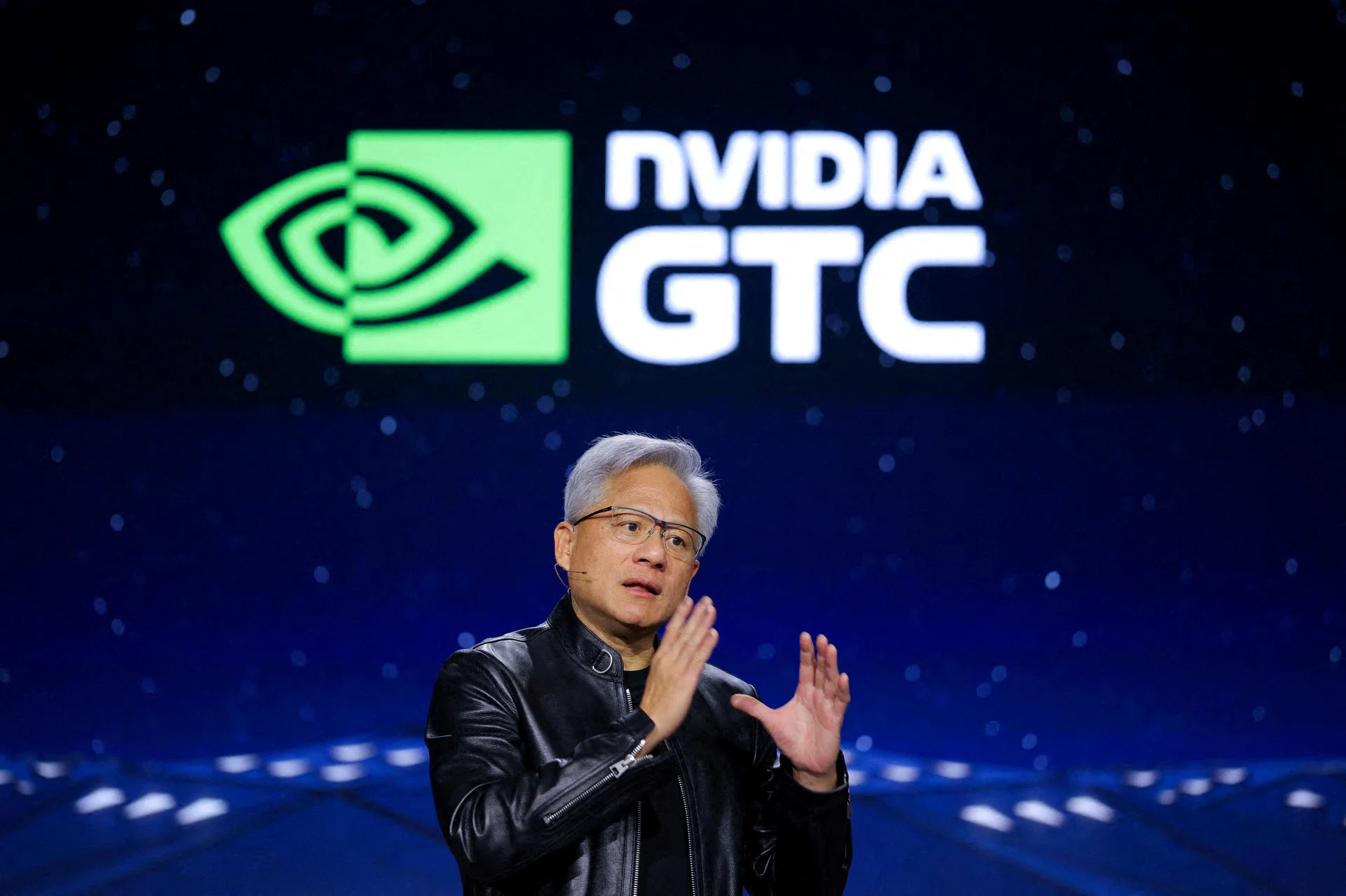
Nvidia's push into physical AI lifts Asian suppliers SK Hynix, Samsung, LG Electronics
The AMW Read
Novelty 2: physical AI supply-chain extension is known trajectory but now validated by concrete partner rallies and production-cost data; Significance 3: cross-segment signal — rewires Robotics (10), Infrastructure (04), and Compute economics simultaneously.
Nvidia's push into physical AI lifts Asian suppliers SK Hynix, Samsung, LG Electronics
Nvidia's expanded physical AI strategy — encompassing robotics, autonomous systems, and AI-enabled manufacturing — has triggered a rally across its Asian supply chain. LG Electronics jumped 15% on reports of robotics platform collaboration; Nanya Technology surged 10%; and Chinese automotive AI firms Huizhou Desay and Pateo Connect also rallied. The moves follow a deepening of chip-level ties with SK Hynix and Samsung Electronics, whose quarterly profits surged fivefold and 48-fold respectively. Asian suppliers now account for roughly 90% of Nvidia's production costs, up from ~65% in 2025.
Why it matters: This marks a structural extension of the hyperscaler-distribution moat beyond generative AI inference into physical-world deployment. Nvidia is effectively using its existing chip-supply leverage to pull Asian manufacturing partners into a new demand pool — robotics hardware, custom silicon for autonomous systems, and edge inference modules. The pattern mirrors the acqui-licensing and partner-expansion playbook that Nvidia used to dominate the GenAI data-center buildout, but now targeting a broader capital-expenditure cycle: Amazon, Microsoft, Alphabet (~$190–200B each for 2026) and Meta (~$145B) are funneling roughly half their AI capex through Nvidia's silicon. The shift also validates a recurring pattern from the Robotics/Physical AI substrate (Segment 10): physical AI deployment is not a separate clean-sheet market but an additive layer on top of existing semiconductor supply-chain dependencies.
The capital-compression arc is asymmetric: Asian suppliers capture the manufacturing volume, but Nvidia captures the system-level margin via its CUDA ecosystem and silicon architecture. The surge in SK Hynix and Samsung profits is a direct consequence of HBM memory demand tied to Nvidia's Blackwell and B300 server lines. Meanwhile, the broadening partner list — from DRAM makers to consumer-electronics OEMs to Chinese automotive solution providers — signals that Nvidia is hedging geopolitical risk by distributing manufacturing dependence across South Korea, Taiwan, and China while keeping platform control in-house. The open debate about whether physical AI will dilute or reinforce Nvidia's compute monopoly is being resolved in favor of reinforcement: physical AI requires the same high-bandwidth memory, advanced packaging, and GPU clusters that GenAI does, just deployed at the edge rather than in data centers.
#Nvidia #PhysicalAI #Robotics #AsianSupplyChain #SKHynix #Samsung #AIInfrastructure