GenSpark launches AI Workspace 6.0, surpassing 7,000 enterprise customers within one year of launch

GenSpark launches AI Workspace 6.0, surpassing 7,000 enterprise customers within one year of launch
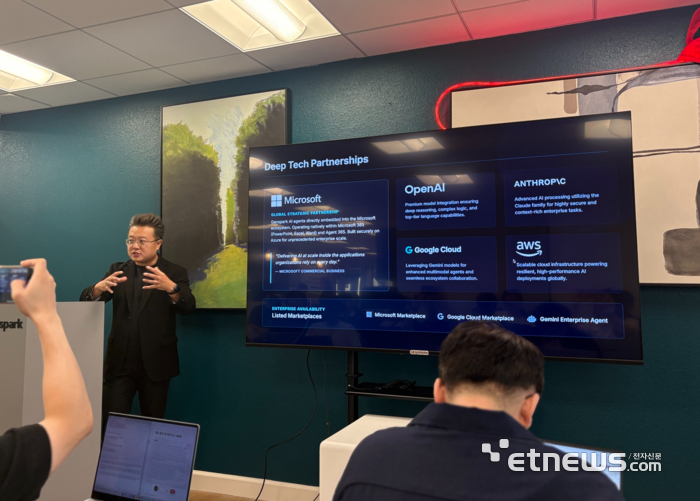
GenSpark, the AI workspace company founded in Silicon Valley in December 2023, has released AI Workspace 6.0, a major update centered on a persistent-memory architecture the company calls SecondBrain. The platform introduces an agent engine that routes tasks across 70+ AI models, 150+ tools, and 20+ datasets, dynamically selecting the best combination for each user request. Alongside the software update, GenSpark debuted a hardware device called SecondBrain Note — a card-sized recorder that captures offline conversations and meetings, converting them into structured memory for the AI layer. The company reported $250 million in annual recurring revenue (ARR) within 12 months of launch, with 7,000 enterprise customers, and has raised $645 million at a $2.6 billion valuation. Microsoft, a partner and investor, is expanding collaboration from cloud infrastructure into the Microsoft 365 ecosystem and marketplace.
Why it matters: GenSpark's trajectory exemplifies the "fastest-ARR-ramp" pattern that has defined the AI application layer, but with a twist. Rather than riding a single foundation model's brand, GenSpark is building an agentic middleware layer that abstracts the model choice from the user — a bet that the value in enterprise AI lies in orchestration, memory, and workflow integration, not model performance. The SecondBrain persistent-memory feature directly addresses the chief complaint among enterprise users of generative AI: the loss of context across sessions. If GenSpark can turn this into a durable switching cost, it may carve a defensible position against the platform plays from hyperscalers like Microsoft and Google Workspace, who are also racing to embed agents into their productivity suites.
Grounded expert take: This is a textbook case of the "context-engineering moat" — the idea that the most defensible AI product is not the best model but the one that accumulates the most workflow-specific memory over time. GenSpark's $250M ARR in 12 months is extraordinary for a workspace tool, but the real signal is the 7,000 enterprise logos. That base gives GenSpark a data-network effect: the more customers use SecondBrain, the richer the memory layer becomes, and the harder it is to leave. However, the company faces a classic hyperscaler-distribution threat: Microsoft is both investor and potential competitor. The extension of their partnership into the M365 marketplace is a double-edged sword — it drives adoption today but deepens dependence on a partner who could build competing agent capabilities into Copilot tomorrow. The hardware play (SecondBrain Note) is a novelty; the lasting story here is whether GenSpark can out-execute Microsoft on agentic memory before the platform absorbs the category.