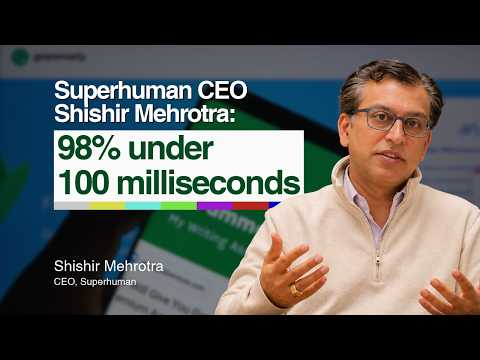
Grammarly's Superhuman Platform Reports 100 Billion Weekly LLM Calls as It Opens Agent SDK
The AMW Read
A scaled incumbent opening its agent platform via SDK meaningfully updates the agent distribution baseline; segment-level impact, not structural.

Grammarly's Superhuman Platform Reports 100 Billion Weekly LLM Calls as It Opens Agent SDK
Superhuman CEO Shishir Mehrotra said in a product-launch interview that Grammarly processes over 100 billion LLM calls per week — more than 2,000 per user per day — and serves 98% of them from its own custom models at under 100 milliseconds of latency. The company is opening its Superhuman Go agent platform to third parties via an SDK, with partners including Databricks and legal AI tool Lora. New updates span Superhuman Mail, Docs, and the recently acquired note-taker Fathom, plus a personal-assistant capability that runs on its own computer with a push-based heartbeat.
The strategic core of Mehrotra's argument is distribution as an inference moat: Grammarly operates across roughly one million applications per day, observing and acting at the cursor rather than requiring users to switch tools. That surface — not raw model quality — is what he calls the "last mile" of enterprise AI, and it is what lets a writing assistant reposition as an agent platform competing with standalone assistants and vertical copilots. For the agent segment, this is a notable data point: the usage volume, latency discipline, and custom-model share suggest Grammarly is functioning more like an inference business than a grammar checker. Superhuman (formerly Grammarly) is tracked in the AI Market Watch index with $400M in equity funding plus $1B in debt financing (2025), per the index, which covers roughly 5,000 companies and is a coverage list rather than a census.
For builders and investors, the open SDK is the piece to watch. If third-party agents run inside Grammarly's million-application surface, the company converts distribution into a platform tax on the agent economy — and Databricks and Lora become reference tenants for that model. The unresolved question, which Mehrotra himself leaves open, is measurement: nobody in the episode offers a settled way to prove AI productivity gains, and without that, enterprise buyers will keep pricing agent suites on seat counts rather than outcomes.