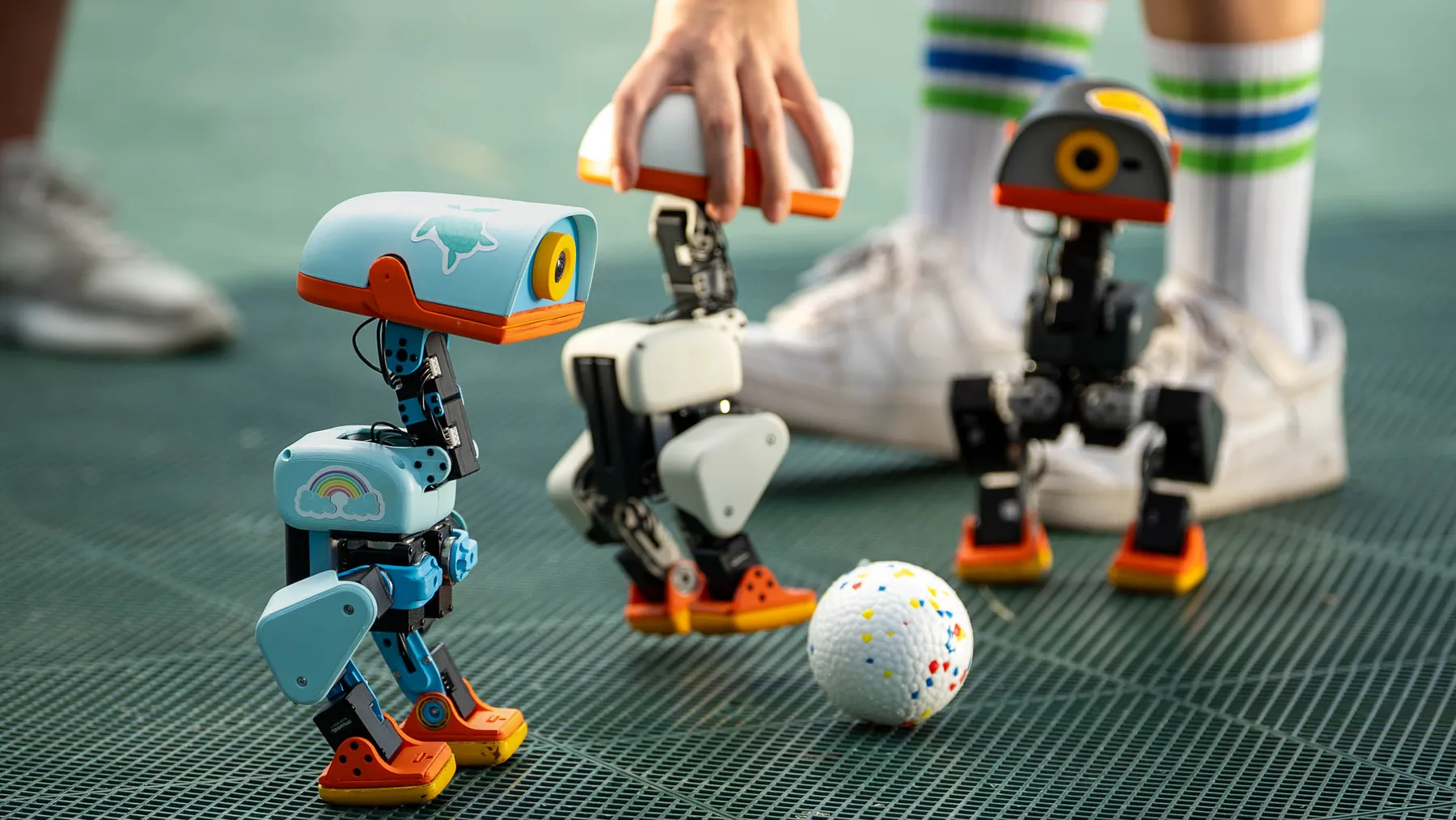
Hugging Face’s $399 Microduck robot generated more than $2.6M in preorder value in its first 24 hours.
The AMW Read
Strong first-day preorder demand for an inexpensive, open-software robot meaningfully advances the developer-platform approach to physical AI, though fulfillment and ecosystem depth remain unproven.

Hugging Face’s $399 Microduck robot generated more than $2.6M in preorder value in its first 24 hours.
Hugging Face subsidiary Pollen Robotics began preorders on August 27 for Microduck, a 25-centimeter bipedal developer robot designed for reinforcement-learning experiments. Co-founder Thomas Wolf said first-day orders exceeded $2.6 million; because that figure includes accessories, it does not translate directly into unit sales. The device includes 15 motors, cameras, time-of-flight sensing, two inertial measurement units, a gripper-like beak, and seven preloaded behaviors, with initial delivery targeted before Christmas in regions including the United States, Europe, Japan, and South Korea.
The significance is less the novelty toy form factor than the distribution model behind it. Pollen positions Microduck as a sim-to-real platform: developers can train behaviors in MuJoCo, export them to the physical robot, and inspect or modify the supplied policies. Its software development kit, simulator, and reinforcement-learning tools are available under an Apache 2.0 license. That approach extends Hugging Face’s familiar model-sharing logic into embodied AI, seeking a common, affordable hardware target on which developers can exchange and test robot behaviors rather than concentrating experimentation in expensive humanoid programs.
For builders, the useful test is whether shared policies reproduce reliably across deployed units and reduce the cost of collecting real-world manipulation and locomotion data. For investors, first-day preorder value is an encouraging demand signal, but not proof of shipped revenue or a durable robotics platform; the key milestones are fulfillment, developer retention, and whether a reusable ecosystem of behaviors emerges around the hardware.