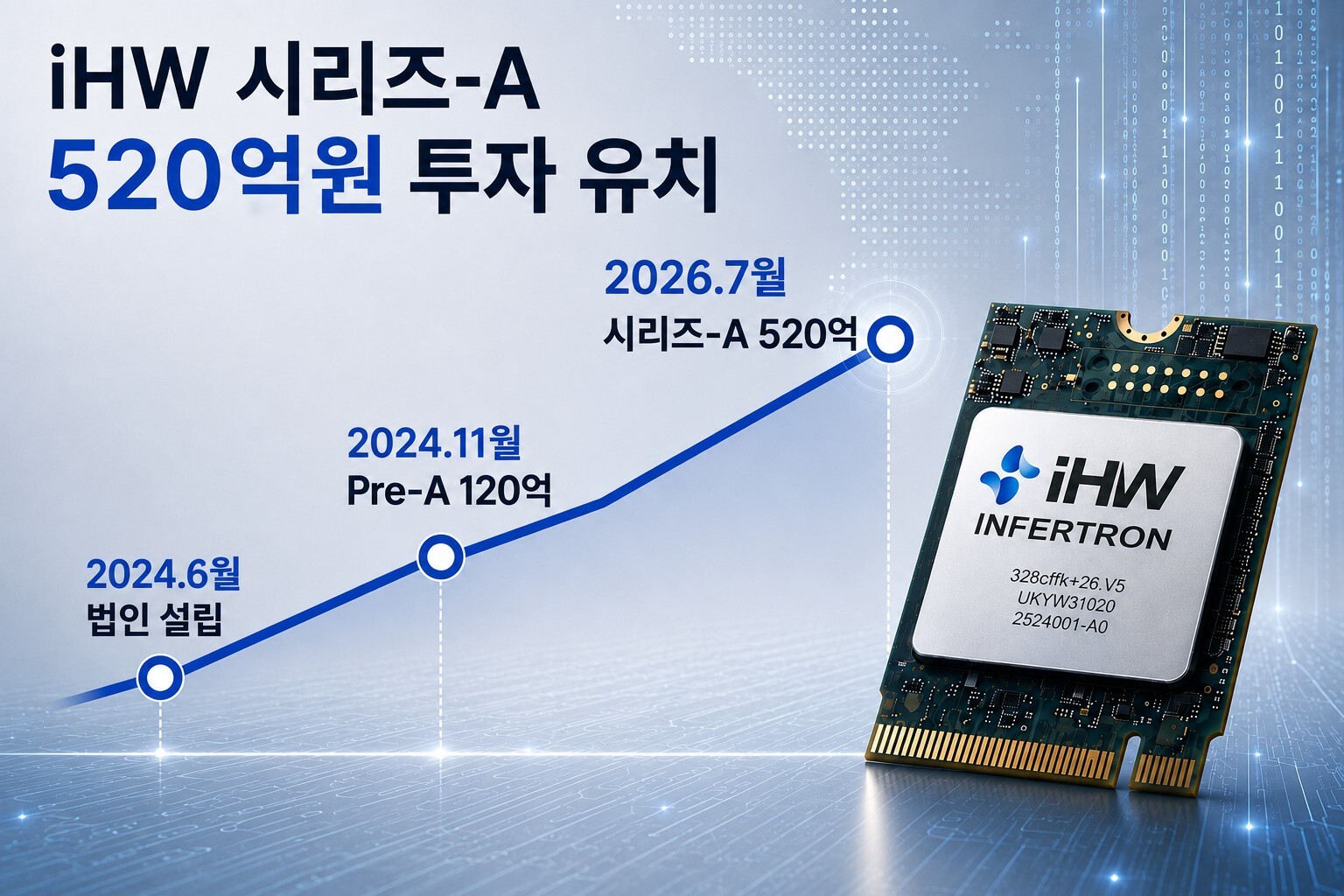
iHW secures 52 billion won (~$38M) Series A
The AMW Read
Incremental update to a known edge-AI chip player; the ACiM approach is notable but not yet proven in volume, and the round size is sub-segment scale.

iHW secures 52 billion won (~$38M) Series A
South Korean fabless startup iHW (아이에이치더블유) has closed a 52 billion won (~$38M) Series A round, bringing cumulative funding to 64 billion won (~$47M). The round was led by Kolon Investment, with follow-on participation from existing backers Woori Venture Partners, Mirae Asset Venture Investment, DSC Investment, and HB Investment, plus new investors including the Industrial Bank of Korea and defense firm LIG Next. The company said it will use the proceeds to ramp production of its edge AI chip, build LLM chip prototypes, and expand headcount.
What sets iHW apart is its analog compute-in-memory (ACiM) architecture, featured in its INFERTRON chip. Unlike digital NPUs that shuttle weights from memory to separate compute circuits, INFERTRON performs computation directly where weights are stored, cutting data movement and power draw. The chip is designed to run without external DRAM or flash, targets mature process nodes rather than leading-edge fabs, and requires no heat sink or cooling—an approach aimed squarely at edge use cases like smart city vision, industrial inspection, and robot joints where battery and thermal constraints limit conventional NPUs.
The round signals growing investor appetite for alternatives to the digital NPU status quo, particularly as data-center power and cooling become bottlenecks for AI infrastructure. iHW's ACiM approach tackles the "memory wall" problem directly, and the company has already secured over $10M in Korean government R&D support for AI semiconductor projects. For edge AI builders, the practical implication is a potential path to cheaper, cooler, and more power-efficient inference at the device level—if iHW can move from silicon validation to volume production without yield or integration surprises.
