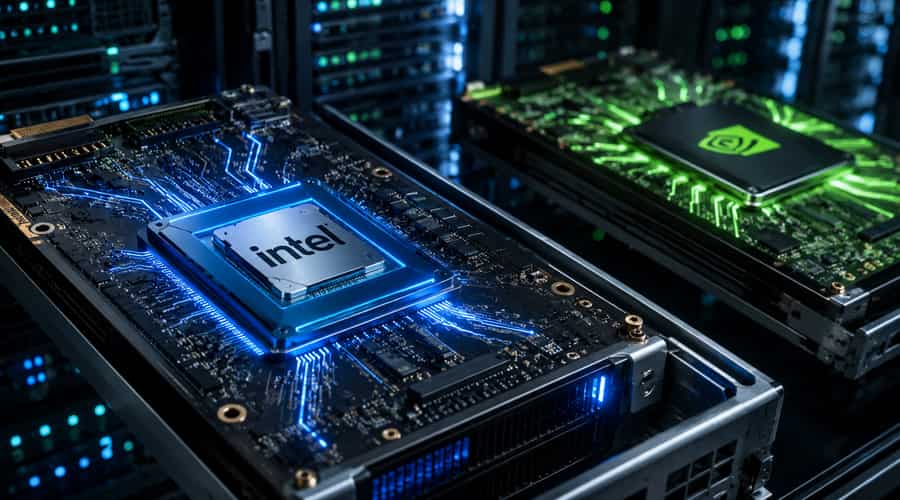
Intel is preparing a new AI chip to challenge Nvidia by end of 2026.
The AMW Read
Intel's chip announcement is a meaningful update to the AI infrastructure player map and silicon dynamics, but does not resolve the open debate about whether any challenger can dislodge Nvidia's moat.
Intel is preparing a new AI chip to challenge Nvidia by end of 2026.
Intel has disclosed plans for a data center GPU codenamed Crescent Island, built on Xe3P architecture and designed specifically for AI inference workloads. Customer sampling is expected in the second half of 2026. The chip uses LPDDR5X memory (160GB reference, up to 480GB in partner designs) rather than the high-bandwidth memory used in Nvidia's top-tier accelerators, signaling Intel is targeting a narrower, more cost-conscious segment of the market. This comes after Intel's Gaudi 3 accelerator failed to gain traction, with the company recording inventory-related charges in 2024 and 2025.
This matters because Intel is trying to exploit a structural opening in the AI chip market: as enterprise AI deployments shift from training to inference, buyers are increasingly prioritizing cost, availability, and ease of deployment over peak performance. The article frames this as the hyperscaler-distribution pattern in reverse — Nvidia owns the full stack from GPU to networking to software, while Intel is betting on its deep relationships with server makers and enterprise IT buyers to place an inference-optimized chip into air-cooled racks. If successful, Crescent Island could give large AI buyers leverage against Nvidia's pricing and supply terms, a dynamic that has been absent since Nvidia's dominance began.
The real test, however, is whether Intel can overcome the software and trust deficits left by Gaudi. Nvidia's CUDA ecosystem and network effects are the deepest moat in AI infrastructure, and Intel's track record of promised alternatives that never disrupted the market will weigh on every enterprise procurement decision. The timing is unforgiving: by late 2026, Nvidia's Blackwell systems will be deeply embedded. Intel's opportunity is real but narrow — winning inference workloads that can be moved without pain from Nvidia's platform, not displacing it in flagship deployments.