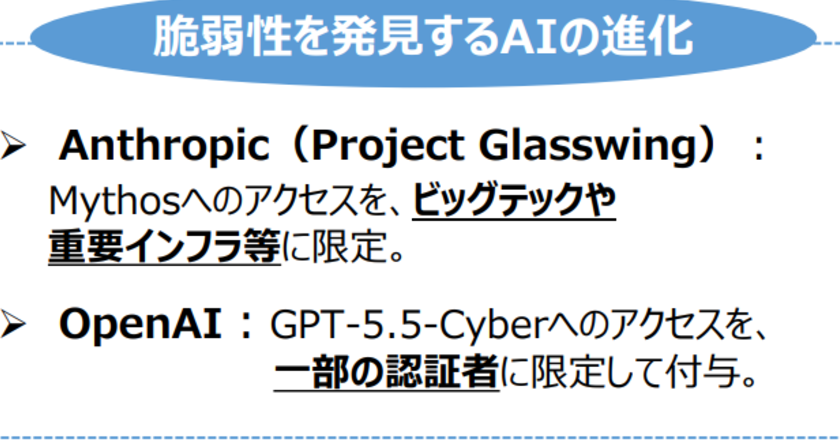
Anthropic has provided the Japanese government with access to its specialized 'Claude Mythos Preview...
The AMW Read
Novelty 2: Updates Anthropic's case study (new government deployment pattern). Significance 2: Sovereign AI cyber defense deployment is segment-level, with cross-substrate geopolitical implications.

Anthropic has provided the Japanese government with access to its specialized 'Claude Mythos Preview' model as part of a sovereign cyber-defense initiative called Project YATA-Shield, according to disclosures made by Japan's Digital Minister on June 3, 2026. The access was granted through Anthropic's broader Project Glasswing security initiative, which the company announced on May 22, 2026, extending capabilities to over 150 organizations across 15 countries. Project YATA-Shield, run by Japan's National Center of Incident Readiness and Strategy (NCO), integrates Mythos to enhance cyber-defense operations against state-backed threats. Japanese officials also confirmed that major financial institutions — including Mizuho Financial Group, Sumitomo Mitsui Banking Corporation, and MUFG Bank — have obtained access. Japan's government emphasized it is engaging with multiple AI firms including Google, Microsoft, and OpenAI for a comprehensive security posture.
The 'why it matters' is that this deployment represents a concrete sovereign adoption of a specialized, security-tuned frontier model for national cyber defense — a pattern that extends beyond typical enterprise procurement into state-level infrastructure. This fits the hyperscaler-distribution pattern where model access is brokered through government security programs rather than open market sales. It also updates the debate around frontier model safety versus utility: Anthropic, known for its safety-first positioning, is actively deploying its highest-assurance model into government cyber operations, validating the thesis that alignment investment unlocks high-stakes government contracts. The Japanese government's insistence that Mythos is 'not a complete solution' and its parallel negotiations with Google, Microsoft, and OpenAI signal that sovereign AI procurement is becoming multi-lab and competitive, not single-vendor locked.
The grounded expert take is that this is a structural win for Anthropic's go-to-market through government security channels — a distribution moat that is expensive to replicate. However, Japan's explicit hedging (engaging multiple labs) shows that sovereign cyber defense is becoming a multi-model procurement category, not a winner-take-most market. The fact that major Japanese banks also gained access suggests a dual civilian-government deployment path, which could accelerate enterprise adoption in regulated industries. This event updates Segment 01's player map (Anthropic as a government security partner) and exemplifies the acqui-licensing pattern in a sovereign context.