JetBrains Central: An open platform for unified AI agent management across dev tools
The AMW Read
Novelty 2: JetBrains extends beyond IDE copilot to governance layer, meaningfully updating its segment role. Significance 2: Resolves 'open vs. closed agent management' debate by bundling policy, cost, and routing into existing toolchain, threatening pure-play agent-monitoring startups.

JetBrains Central: An open platform for unified AI agent management across dev tools
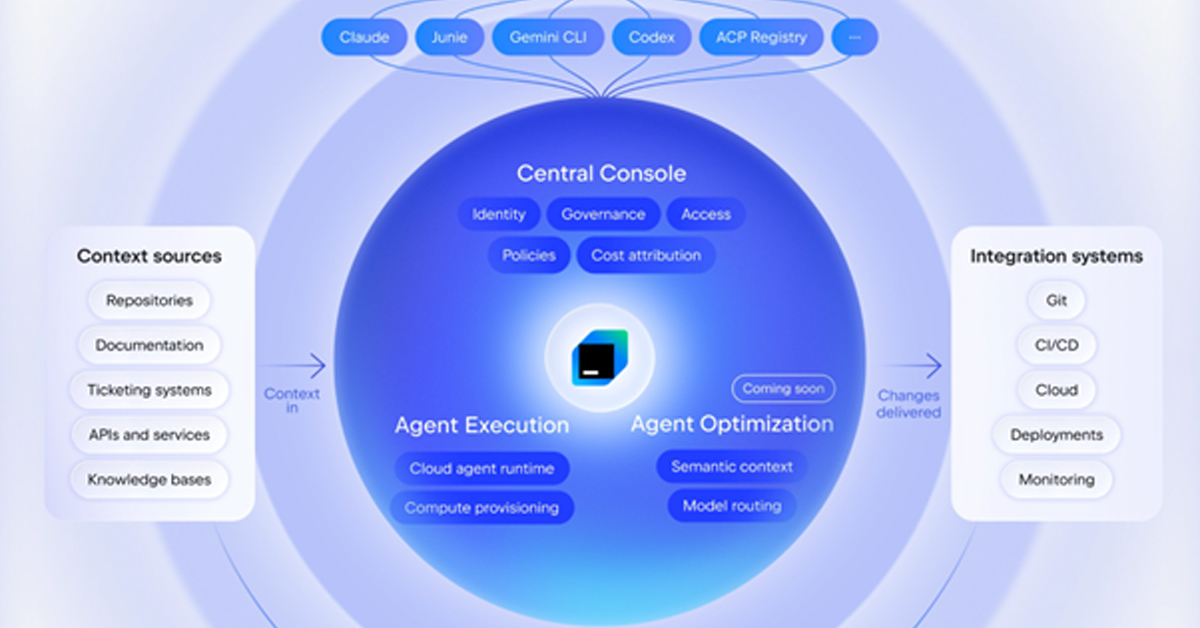
JetBrains has announced 'JetBrains Central,' a unified management system for AI agents across the software development lifecycle. Announced on March 24, 2026, JetBrains Central provides three core capabilities: governance and control (policy application, access management, cost allocation), a unified agent runtime and computing resource provisioning layer, and agent optimization via contextual semantic context that routes tasks to appropriate models and tools. The platform supports JetBrains IDEs as well as third-party IDEs, CLI tools, and web interfaces. It also integrates external coding agents including Claude, Codex, and Gemini CLI, allowing teams to operate agents like Slack or Linear without switching to a dedicated AI workspace.
The launch updates the 'context-engineering moat' pattern described in our AI coding substrate. JetBrains is not building a proprietary agent but rather a control plane that governs heterogeneous agent use across an organization — a shift from point-product differentiation to orchestration-layer governance. This responds to the 'shadow AI' risk (developers using untracked external coding agents) that has emerged as a structural concern for enterprise DevSecOps teams. By positioning itself as an open system that works with Claude, Codex, and Gemini CLI, JetBrains is leveraging its existing IDE distribution to become the policy layer for AI-augmented development, similar to how hyperscalers monetize inference through API gateways rather than just model access.
The key strategic signal is that JetBrains is accelerating its move from IDE vendor to AI middleware provider. This reinforces the pattern that established toolchain incumbents with developer trust can capture the governance layer around AI agents — a market currently fragmented between point solutions (AI firewalls, agent monitoring tools) and platform-wide MLOps systems. The threat to pure-play agent monitoring startups is tangible: JetBrains bundles agent cost tracking, policy enforcement, and context routing into a tool developers already use daily. Whether enterprises will trust JetBrains to govern production AI agent behavior — as opposed to just development-time code completion — is the open debate this launch precipitates. The 'open system' framing is a defensive moat play against lock-in fears, but it also commoditizes the agent-level differentiation of Claude and Codex by routing them through a single pane of glass.
#JetBrains #AgentGovernance #ContextEngineering #AICoding #DevTools #EnterpriseAI