SpaceX acquires Cursor for $60B after IPO, folding xAI into AI coding push
The AMW Read
Resolves the acqui-licensing debate for AI coding tools at hyperscale; $60B explicit deal price triggers cross.§D capital-cycle ref. Updates canonical case study on Cursor (§4.3).

SpaceX acquires Cursor for $60B after IPO, folding xAI into AI coding push
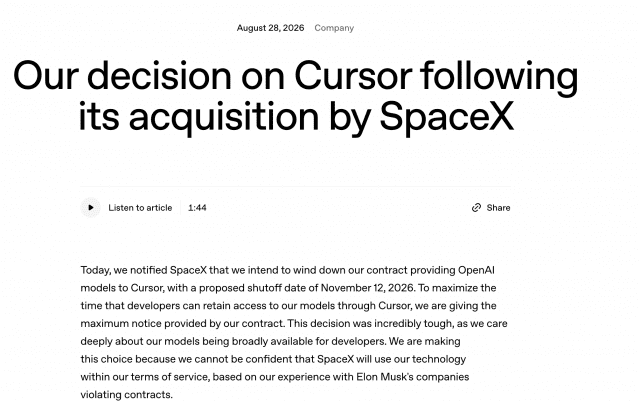
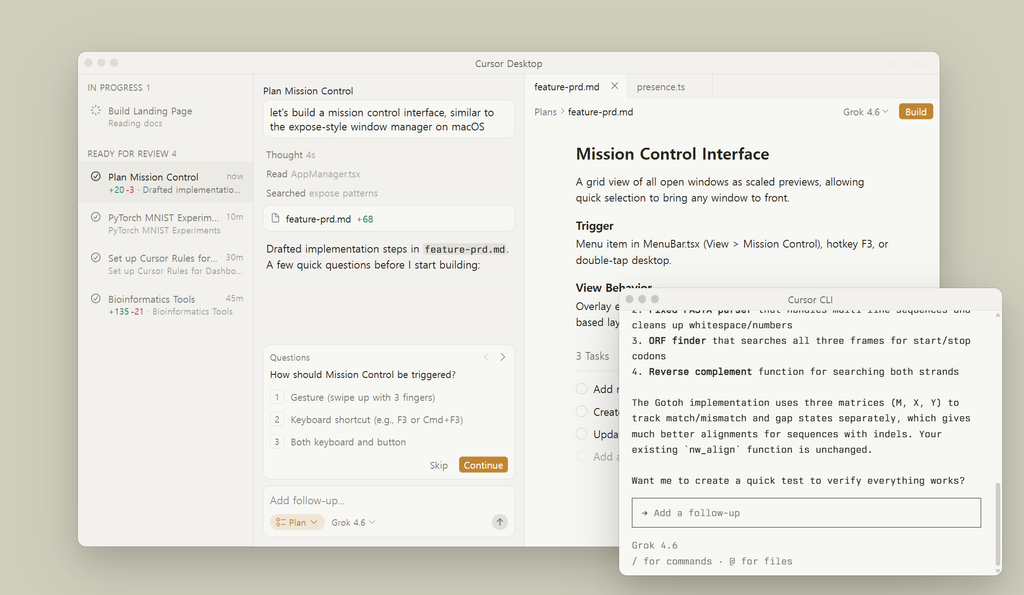
SpaceX completed the largest IPO in history this month and promptly announced the acquisition of Cursor, the AI coding startup behind the widely adopted developer tool, for $60 billion. The deal, disclosed Tuesday, follows an April arrangement giving SpaceX the right to buy Cursor or pay a $10 billion breakup fee. Cursor’s parent company Anysphere will become a wholly owned subsidiary of SpaceX, which earlier this year merged with Musk-owned AI lab xAI in a deal valuing the combined entity at $1.25 trillion. Cursor carried roughly $2.6 billion in annualized B2B revenue at time of deal, serving clients including Adobe, Stripe, and Nvidia.
Why it matters: This acquisition exemplifies the hyperscaler-distribution pattern in AI markets, where compute-rich players buy proven product distribution rather than building in-house. Cursor gave SpaceX what xAI’s Grok model lacked: a widely adopted, revenue-generating AI coding tool with deep enterprise penetration. The price reflects the premium on distribution moats in the AI coding segment, even as Cursor’s market share had slipped from 41% to 26% over the past year, with Anthropic now controlling half the category. For SpaceX, the deal combines Cursor’s user base with its Colossus supercomputer infrastructure in Memphis, aiming to build what it calls the world’s most useful AI coding models.
The acquisition validates the pattern of capital-compression in the AI coding tool segment: Cursor had been raising a $2 billion round from top-tier VCs but that round did not close, with the startup unable to reach break-even on its own. Meanwhile, xAI posted a $6.35 billion operating loss in 2025 and saw all 11 co-founders depart after safety incidents with Grok. The deal signals that even well-funded AI coding tools face an acqui-licensing endgame, where absorption by a larger, compute-advantaged parent becomes the most viable path to scale.