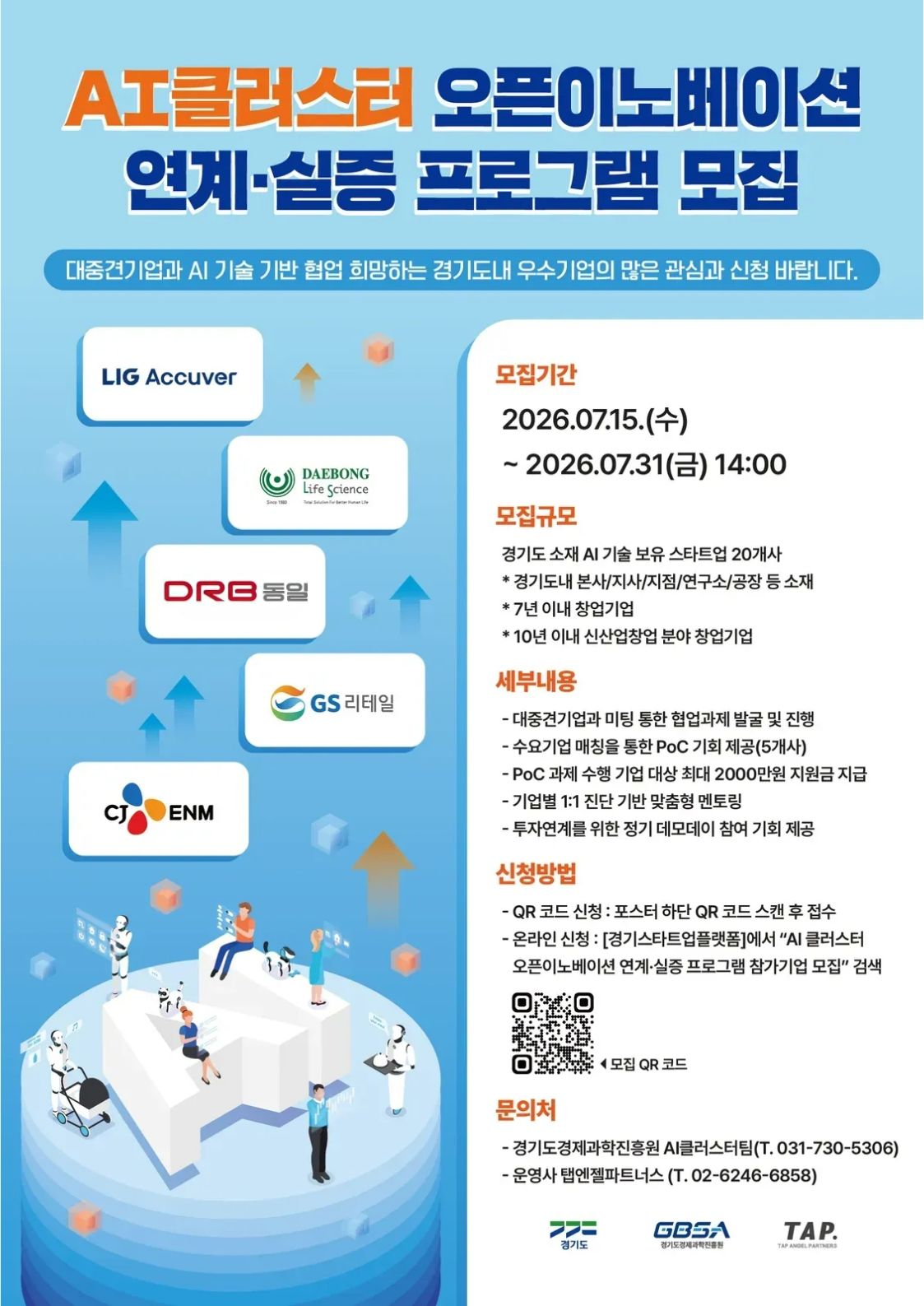
LIG AQUBE and CJ ENM Join Gyeonggi AI Cluster Open Innovation Program for PoC Funding
The AMW Read
Modest PoC funding program confirms known regional AI startup support pattern; significance limited to sub-segment Korean AI ecosystem.
AI Infrastructure
LIG AQUBE and CJ ENM Join Gyeonggi AI Cluster Open Innovation Program for PoC Funding
Gyeonggi Province and the Gyeonggi Business & Science Accelerator (GBSA) have launched the '2026 AI Cluster Open Innovation Linkage & Demonstration Program,' recruiting up to 20 AI startups for proof-of-concept (PoC) funding and commercialization support. The program will select 5 finalists from the pool, providing each with up to 20 million won (~$14,400) in PoC demonstration funding. Participating demand-side companies include LIG AQUBE and CJ ENM, alongside three other large and mid-sized enterprises.
Why it matters: This program exemplifies the ‘government-facilitated open innovation’ pattern increasingly common in East Asian AI ecosystems, where regional economic development agencies act as matchmakers between young startups and established industrial conglomerates. The 20 million won per startup is modest by global standards, barely covering a few GPU-hours at frontier-model training scale, but the value proposition lies less in the cash and more in the distribution and pilot access pathway to corporate partners like CJ ENM (media/entertainment) and LIG AQUBE (defense/advanced manufacturing). This mirrors the ‘hyperscaler distribution moat’ dynamic seen in the US and China, but refracted through a public-private partnership lens. For startups in the Gyeonggi AI cluster, the program provides a low-friction entry point for enterprise PoCs that might otherwise require months of business development.
A grounded take: From a market-structure perspective, the most notable element is the inclusion of LIG AQUBE, a defense/aerospace group, as a demand-side partner. Defense AI applications in South Korea have historically been siloed; this signals a gradual opening of that sector to external startup innovation. The program’s design also reflects a deliberate effort to segment the AI startup landscape by maturity: 20 companies receive mentoring and IR demo-day access, then only 5 graduate to PoC funding. This tiered funnel is a pragmatic response to the capital-compression arc affecting early-stage AI globally, where seed-stage startups struggle to secure follow-on funding. Gyeonggi Province is effectively deploying public capital to de-risk early commercial validation, which may increase the survival rate of its AI startup cohort relative to peer regions.
#AIStartup #OpenInnovation #SouthKorea #EnterpriseAI #PoCFunding #GyeonggiAICluster