Microsoft explored Cursor acquisition but backed out before SpaceX's $60B deal
The AMW Read
The article updates the player map for AI coding tools (Cursor, Copilot, Codex, Claude Code) and exemplifies the hyperscaler-distribution pattern (Section 5). Significance is 3 because the SpaceX-Cursor deal could restructure the competitive landscape.

Microsoft explored Cursor acquisition but backed out before SpaceX's $60B deal
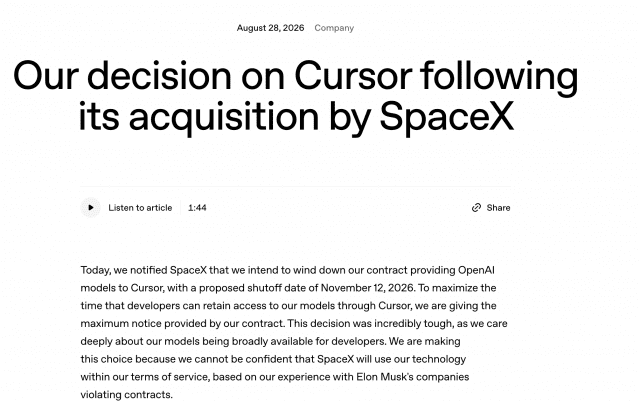
Microsoft considered acquiring AI coding startup Cursor but ultimately decided not to submit a bid, CNBC reported on April 23, citing multiple sources. The move was part of Microsoft's broader strategy to strengthen its position in the AI-assisted coding market, which it already serves with GitHub Copilot. The decision came before SpaceX agreed to acquire Cursor for $60 billion, with a break fee of $10 billion should the deal fall through. OpenAI had also previously considered acquiring Cursor but was rebuffed. Meanwhile, OpenAI's Codex has reached 4 million weekly active users, and Anthropic's Claude Code has achieved $30 billion in annual recurring revenue.
Why it matters: Cursor's acquisition saga exemplifies the hyperscaler-distribution pattern playing out in developer tools: instead of building internally, big tech and well-funded labs are acquiring high-velocity coding startups to lock in developer mindshare and distribution. Microsoft's retreat suggests it judged that integrating Cursor would conflict with its existing Copilot franchise and its dual role as an infrastructure provider to OpenAI and Anthropic. The SpaceX deal, if completed, would combine Cursor with xAI's models, creating a vertically integrated coding platform that bypasses the usual model-lab dependency — a structural shift that tests whether the "acqui-licensing" of AI coding tools becomes the dominant go-to-market strategy.
Grounded expert take: Cursor sits at the intersection of the fastest-ARR-ramp pattern in AI: a coding assistant that achieved remarkable adoption by being model-agnostic and tightly integrated into developer workflows. Microsoft's hesitation, despite its deep pockets, highlights the strategic tension between owning a best-in-class developer product (Cursor) versus defending an existing platform (Copilot) that relies on multiple model providers. The real winner may be the Cursor team itself, which has extracted a massive premium from bidders. If the SpaceX deal closes, it will create a new top-tier lab with direct distribution to both software engineers and, potentially, xAI's broader consumer base — a configuration that could accelerate the commoditization of model-layer coding assistants.