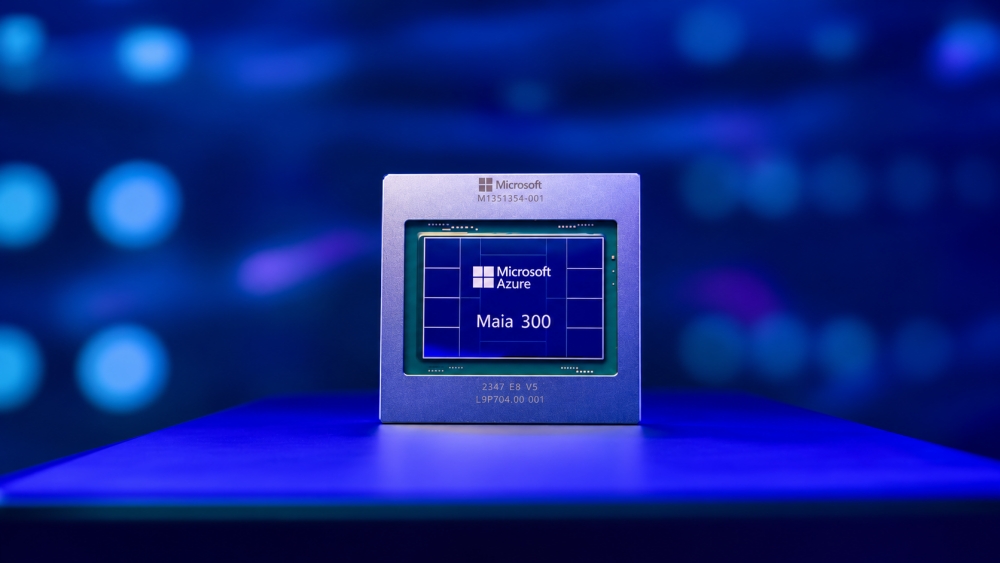
Microsoft plans multigigawatt Maia deployment from 2027 with inference-focused Maia 300
The AMW Read
The report adds deployment and architecture detail to the Maia 300 announcement already covered, while the planned multigigawatt inference fleet could affect economics across Microsoft's AI services.

Microsoft plans multigigawatt Maia deployment from 2027 with inference-focused Maia 300
Microsoft plans to expand its Azure Maia accelerator fleet to multigigawatt scale from 2027 and make it a primary inference platform for its products and services. Its third-generation Maia 300 targets long-context processing, memory-intensive computation, and large-scale decoding. Microsoft projects 40% more tokens per megawatt than major GPU-based systems and up to seven times Maia 200's rack throughput in a configuration containing 96 accelerators. These are company projections, with deployment still ahead.
The market significance lies in Microsoft's ability to design inference silicon around workloads it already operates. Maia 200 serves Microsoft Copilot and supports OpenAI, MAI, and open-source models; GitHub Copilot and Microsoft Foundry adoption is planned by year-end. Maia 300 combines eight HBM4 stacks, up to 18.0 TB/s of memory bandwidth at 950W TDP, and compute chiplets manufactured on TSMC's N2P process. Its software-defined dataflow architecture aims to reduce data movement across compute, memory, and networking. This gives the hyperscaler a route to improve inference economics through coordinated hardware and application design.
For builders evaluating Azure inference, the concrete question is whether those projected efficiencies translate into better pricing and latency for their own models. Long-context conversations and multistep agent workloads are explicit design targets, but the report provides no customer pricing or independently validated comparisons. Investors should distinguish the announced deployment scale from demonstrated economics: power efficiency and rack throughput use different denominators, and neither alone establishes a lower cost per completed task.