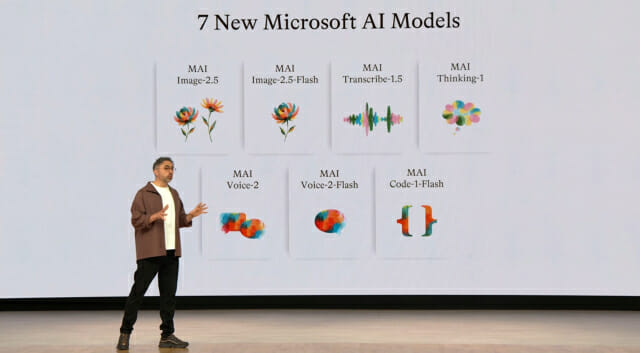
Microsoft unveiled seven new MAI-branded multimodal models at its Build 2026 developer conference, m...
The AMW Read
Meaningfully updates the foundation-model player map as Microsoft pivots from OpenAI dependency to proprietary MAI stack, with cross-segment enterprise distribution implications.
Microsoft unveiled seven new MAI-branded multimodal models at its Build 2026 developer conference, marking a strategic shift toward proprietary frontier AI. Mustafa Suleyman, CEO of Microsoft AI, introduced the MAI family including the reasoning model MAI-Thinking-1, coding model MAI-Code-1-Flash, image model MAI-Image-2.5, transcription model MAI-Transcribe-1.5, and voice model MAI-Voice-2. The models span image, speech, transcription, coding, and reasoning tasks and were trained from scratch on "clean data" without distillation from third-party models, according to Suleyman. Microsoft also launched Frontier Tuning, a reinforcement-learning service that adapts models to enterprise-specific workflows, and claimed its Excel-tuned MAI model matches OpenAI GPT-5.4 performance at one-tenth the cost.
Why it matters: This move reshapes the foundation-model competitive map. Microsoft, historically reliant on OpenAI through its Azure partnership and investment, is now committing to a parallel in-house model stack — an acqui-licensing play built on talent acquired via the Inflection AI deal (Suleyman's former company). The emphasis on data ownership, clean training, and per-enterprise control targets the exact pain point that is opening up in enterprise AI procurement: companies want frontier capability without losing custody of their proprietary data to a model provider. Microsoft's go-to-market vector — bundling through Azure Foundry, GitHub Copilot, Visual Studio, and the broader Microsoft Stack — gives it a hyperscaler-distribution moat that pure-play model labs cannot match.
Grounded take: The subtext here is competitive tension with OpenAI. Microsoft is signaling that it can build competitive frontier models without being held hostage by a single external supplier. The MAI-Thinking-1 claim — beating Anthropic Sonnet 4.6 in blind preference tests — and the 10x cost efficiency over GPT-5.4 on Excel workflows suggest Microsoft is commoditizing reasoning and coding capabilities to sell deeper into its existing enterprise base. The Frontier Tuning service is the real strategic weapon: it moves the value capture from the model itself to the enterprise integration layer, which is Microsoft's fortress. If this lands, it compresses margins for standalone model providers while expanding the total addressable market for AI in office productivity.