Robbyant releases open-source models for robot navigation and spatial memory
The AMW Read
The release adds open-source mapping and navigation models to robotics, but its reported results do not establish deployed performance.

Robbyant releases open-source models for robot navigation and spatial memory
Robbyant, an embodied AI company within Ant Group, has released LingBot-Map 2.0 and LingBot-Navi. The models target mapping errors and the loss of spatial knowledge between robot missions. Robbyant also released technical reports, source code, model weights, and a dataset covering 511 captured real-world scenes. LingBot-Map 2.0 uses an internal correction mechanism that reuses geometric information to update its spatial representation without processing images again.
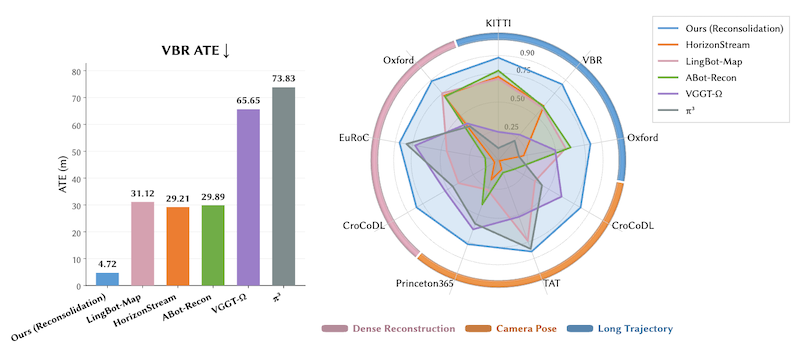
The release adds open-source tools to the embodied AI market, where navigation and spatial memory support applications from warehouse logistics to domestic robotics. Robbyant reports that average trajectory error on a 5.2-kilometer urban test fell from 31.12 meters with the original mapping model to 4.72 meters with version 2.0. For LingBot-Navi, the company reports a 68.60% task success rate on a subset of the GOAT-Bench simulation benchmark. These are company-reported results, and the navigation score does not establish performance in a deployed robot.
Builders can examine the released code, weights, reports, and real-world scene dataset when assessing the models for their own navigation systems. LingBot-Navi can retrieve stored information about objects and locations for natural-language commands and supports on-device operation. Its reported fully end-to-end simulation success rates were 56.09% on GOAT-Bench and 32.36% on Robbyant's proprietary dataset, making task and environment selection relevant to evaluation.