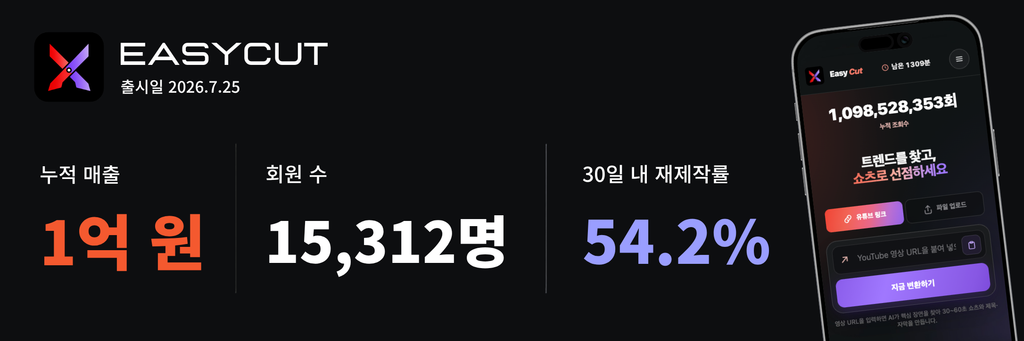
EasyCut posts 100 million won (~$75K) revenue and 15,000 members in seven weeks
The AMW Read
New Korean shorts-editing entrant with early revenue and conversion metrics updates the generative-media player map but remains a sub-segment traction story, not a segment-level shift.

EasyCut posts 100 million won (~$75K) revenue and 15,000 members in seven weeks
Solo-founded Korean AI short-form editor EasyCut (이지컷), run by Artirum (아티룸), said it passed 100 million won (~$75,000) in cumulative revenue and 15,000 registered members within seven weeks of its July 25 launch. Users drop in a video link or file; the model picks key scenes and attaches titles and captions to produce a shorts draft. An "AI comment template" that overlays reaction phrases matched to the clip’s context is under patent application. Discovery includes real-time popular clips and a reuse-allowed catalog of CC BY-licensed sources the company says exceed 1 billion combined views, while users must still check third-party rights and platform monetization rules.
Company-reported funnel numbers are unusually concrete for a seven-week consumer media AI tool: 40.6% of users who created at least one video have paid, and 54.2% of creators a month past first production remade a video within 30 days. That paid conversion and remake cadence matters in generative media, where short-form editors win on repeat workflow speed rather than one-off novelty, and where licensed reusable footage is a practical hedge against the segment’s copyright exposure. In August EasyCut also signed a B2B contract with a domestic broadcaster and began supporting company-specific templates, moving a side-hustle creator product into institutional short-form pipelines.
For builders and investors, the takeaway is early product-market fit on a narrow shorts stack—ingest, clip, caption, reaction overlay—sold to creators running channels beside a day job and now tested with broadcast buyers, not a model-lab story. The figures to watch as the base scales are whether the roughly 41% pay rate and 30-day remake habit hold, and whether CC BY sourcing plus user-side rights disclaimers remain enough as commercial reuse grows.