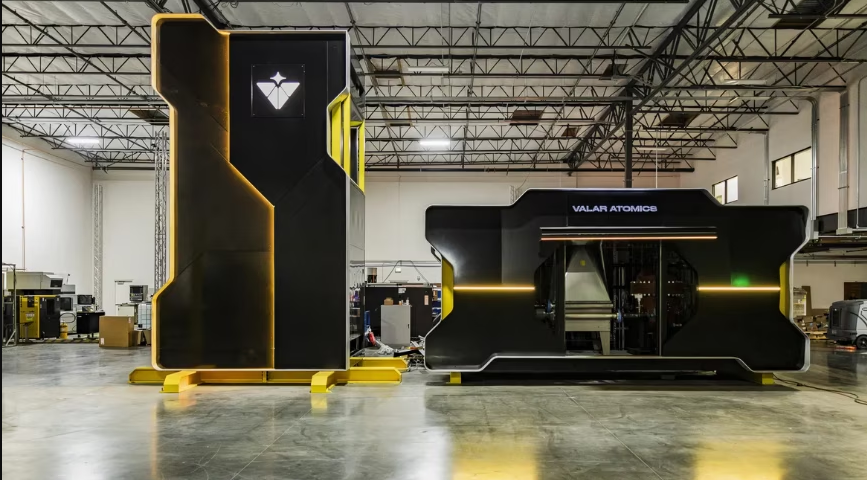
Valar Atomics raises $1B Series B to mass-produce small nuclear reactors for AI data centers
The AMW Read
Novelty 1 as Valar is a new entrant in a crowded SMR space with a familiar thesis; significance 2 as the $1B raise and Nvidia partnership update the segment-level capital cycle for AI compute infrastructure.

Valar Atomics raises $1B Series B to mass-produce small nuclear reactors for AI data centers
Nuclear energy startup Valar Atomics announced a $1 billion Series B funding round led by Sequoia Capital, with participation from nine other venture firms including Valor Equity Partners and Conviction, alongside a separate $200 million credit facility. The company plans to shift from prototype demonstration to mass production of small modular reactors (SMRs) on assembly lines, aiming to deliver hundreds to thousands of units per year directly to AI data centers and industrial sites. Valar previously demonstrated its Ward-250 test reactor powering Nvidia Blackwell GPUs at a data center in June 2026, and has an expanded partnership with Nvidia to build a 30-megawatt nuclear-powered AI facility in Utah.
Why it matters: This event sits at the intersection of two structural forces in the AI substrate — the capital-intensive build-out of compute infrastructure (cross.§A) and the massive capital flows now chasing AI-adjacent energy solutions (cross.§D). The $1B round signals that the AI industry's power demand bottleneck has become acute enough to warrant nuclear-scale capital commitments, validating the thesis that compute economics are increasingly constrained by energy availability, not just GPU supply. Valar's approach of manufacturing SMRs on production lines, analogous to car manufacturing, directly addresses the capital-cycle dynamics of hyperscaler AI build-out, where time-to-power is becoming as critical as time-to-compute.
Expert take: While Valar Atomics is a new entrant in the SMR space, the pattern of startups raising nine-figure rounds to solve AI's energy problem is now well-established, with competitors X-energy ($700M going public), Radiant Industries ($300M), and Aalo Atomics ($100M) all having raised significant capital. The critical differentiator here is Valar's demonstrated integration with Nvidia's hardware, which provides a hyperscaler-distribution moat that could accelerate adoption. However, the path from prototype to mass production at energy-grid scale remains unproven in the U.S., and the company's success will depend on regulatory approval, supply chain maturation, and the ability to deliver SMRs at costs competitive with natural gas and renewables. The $1B raise is a bet on that thesis, but the technology still faces the same capital-cycle risks that have haunted nuclear projects for decades.