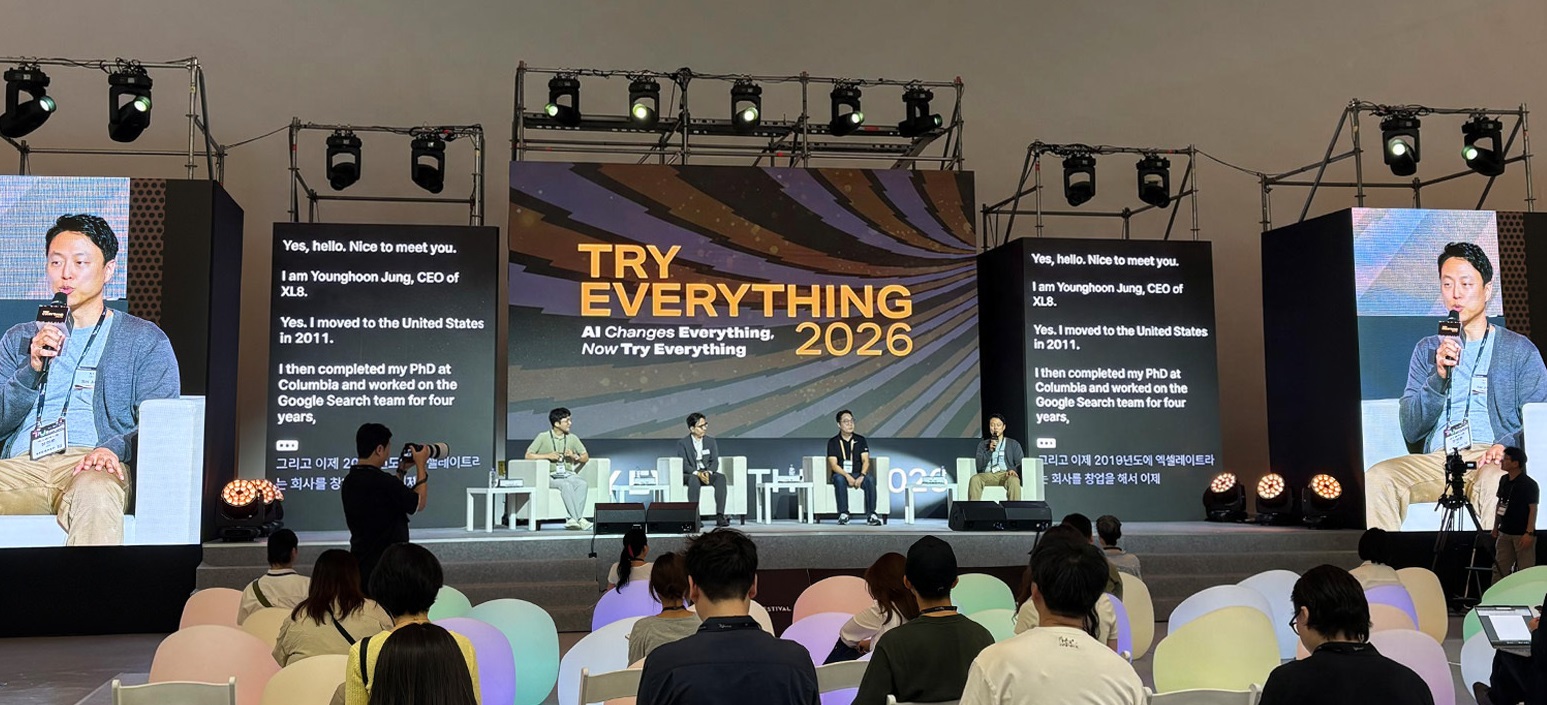
XL8 supplies real-time AI captioning to Try Everything 2026, its third major Korean startup event
The AMW Read
XL8 extends an already-established real-time captioning business to a third major Korean startup event, with no new funding, model, or structural signal disclosed.

XL8 supplies real-time AI captioning to Try Everything 2026, its third major Korean startup event
XL8 provided its EventCat real-time AI translation and captioning system across more than 40 sessions running simultaneously in three venues — DDP Art Hall 1, Art Hall 2, and the Conference Hall — during Try Everything 2026, held September 9-10 in Seoul. The toughest test was the final of the Seoul Unicorn Challenge, where seven domestic and international startups pitched back to back, producing a dense stream of unfamiliar company names and technical terms. XL8 said it pre-loaded a custom glossary of startup, investment, and IT terminology before the event to raise accuracy, and relied on its own simultaneous machine translation engine — which segments speech into partial units instead of waiting for complete sentences — to hold average caption latency under two seconds.
The deployment extends a run that already includes four consecutive years at NextRise and a booking at Comeup last December, making XL8 the incumbent captioning vendor across all three of Korea's marquee startup events. It also runs EventCat outside the country, including at Sushi Tech Tokyo 2026 and corporate gatherings such as SK Hynix's Future Forum. Per the AI Market Watch index, our pipeline logged no new coverage of XL8 in the trailing 90 days versus one item in the prior 90 (name-matched, pipeline-ingested sources only) — consistent with a business growing through conference renewals rather than discrete news events.
For builders, the defensible layer here is domain glossary tuning and low-latency streaming architecture, not the underlying translation model — accuracy inside a room full of unfamiliar startup names is what organizers actually pay for. XL8's stated next step, pairing captions with voice interpretation matched to speaker gender and event tone, points toward bundling speech synthesis onto its existing pipeline, positioning it to compete for full audio-interpretation budgets currently split between human interpreters and separate TTS vendors.